
Tag: volunteer
Garry Kicks Off The Planting Season!
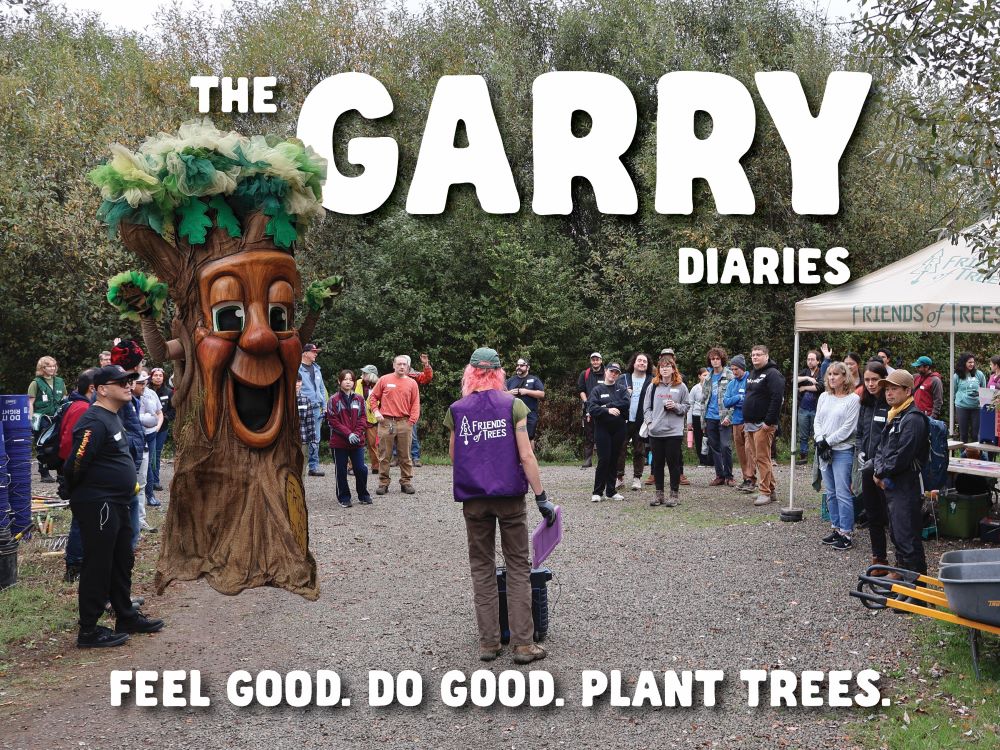
Dear Diary,
The 37th planting season has started, can you believe it? I know that in Oregon white oak years, I’m just a kid. I’m only 37, and I could live to be 500! So this diary isn’t a mid-life crisis, or even a quarter-life crisis. I’ve just had some awesome experiences lately and want to write about them on paper and not just in my growth rings.
My leaves may be starting to turn and my friends are winding down toward winter dormancy, but I’m getting revved up for the Friends of Trees planting season. I went to my first event of the season last week and wow, the vibes were so good.
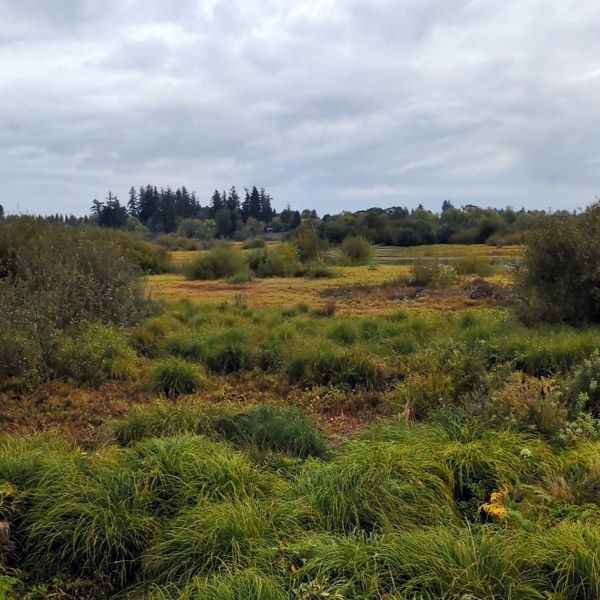
You know me, I’m a savanna kind of tree. But that’s what made going to Jackson Bottom Wetlands such a refreshing change of pace! This 635 acre wetland is really somethin’ special. So many birds were flying overhead! Our planting season kicks off there in October before the rains come. Turns out, wetlands can be pretty dry…until they aren’t.
But no muckboots were needed as 60 volunteers rolled in on that gorgeous Saturday morning. You know those crispy mornings when you can tell that the sun is going to come up warm and burn off the mist? It was one of those! Ugh, it just feels so good. I just love fall mornings like that.
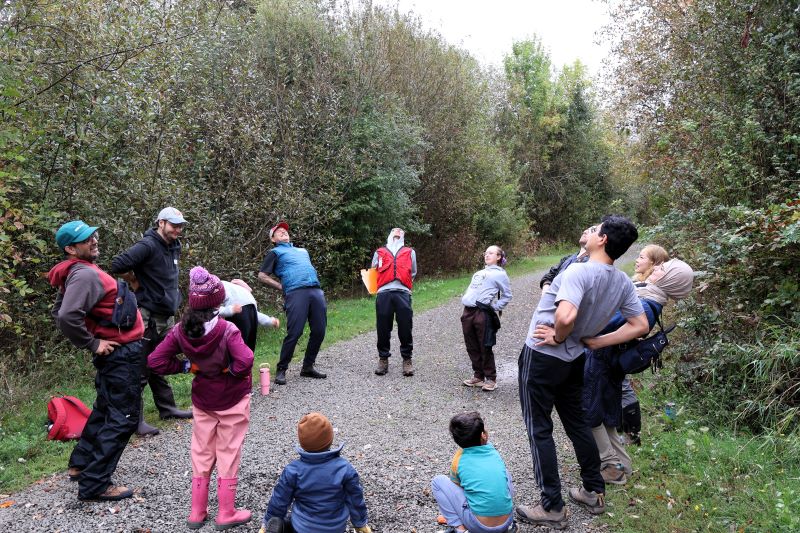
Volunteers arrived with their families or friends or even by themselves, ready to feel good by doing good. We even had Hillsboro’s Japanese Community Day volunteers bring a group of 12 for their 27th year(!) working at Jackson Bottom. This is Friends of Trees’ 12th season at Jackson Bottom, and it is so exciting to see how much impact our volunteers have had. I love the crew huddle where we get to know each other. And stretch!
Oh yeah, I mentioned feeling good a couple times already. I should probably mention that that’s our theme this year:
FEEL GOOD. DO GOOD. PLANT TREES.
Makes sense right? People plant trees and native plants for so many reasons. To get outside, to make their communities greener, to provide bugs and critters with food and homes, to fight the big bad villain that is climate change. I think everyone does it because it feels good to do good.
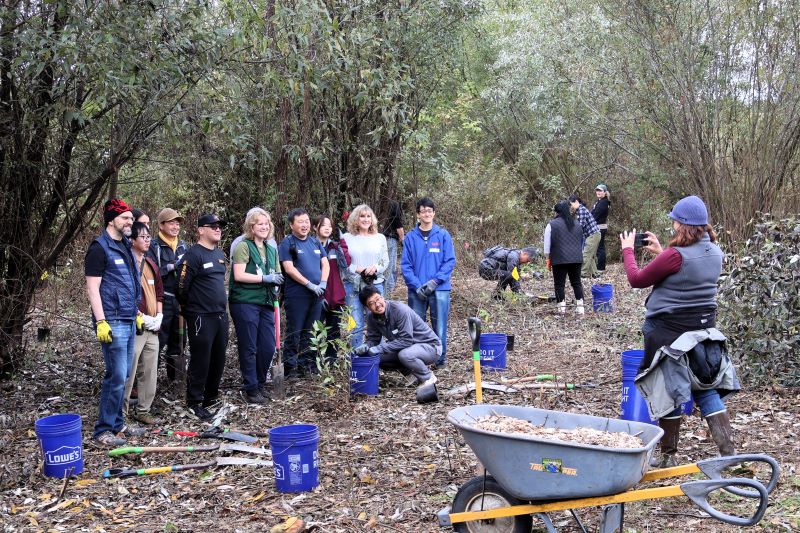
There’s so much going on in the world. It can be rough, even for me, an Oregon white oak that is going to live for 500 years. So it’s nice to spend a Saturday morning meeting new people and planting a buttload of trees.
So that’s what we did! We planted 600 black cottonwoods! Populus trichocarpa are dear friends of mine, and I think they are gonna LOVE it on the forested edge of this wetland. Especially after being planted by people who care about trees, about community, and who make sure to take care of each other, too.
By midmorning, there were so many flannels and fleeces piled by the trail. It warmed up, just like I knew it would, and the sun shone on so many smiling faces. I just kept thinking, enjoy each moment, get to know each tree.
The season is just getting started! I may accidentally leave this diary somewhere someone might find it. That’s okay, this isn’t a secret diary. If you’re reading this, COME PLANT TREES WITH US. IT WILL FEEL AWESOME!
Tree-mendously yours,
Garry
P.S. Sign up to volunteer already!
P.P.S. You can support these good vibes and good trees by donating!
Erik’s 25th Planting Season!
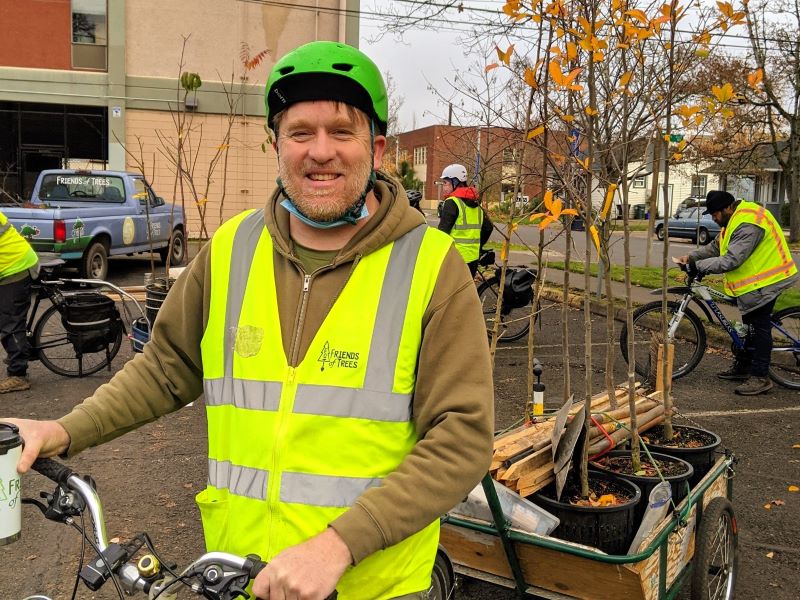
A note from Eugene Director Erik Burke as he enters his 25th planting season
The planting season in Eugene and Springfield is almost here, and if you ask me what I’m looking forward to the most, it’s simple: I’m just really looking forward to planting with volunteers. We’ve built up a great core of volunteers, and I know that I’ll get to meet cool new people, too.
I started with Eugene Tree Foundation in 2001—we were a little more ragtag then— and we officially became the Friends of Trees Eugene Branch in 2011. That means this will be my 25th season. Regardless of whether or not I’m feeling the years, I still get really happy on planting days, and I even find myself floating for a few hours afterwards.
I was talking with my teammate Taylor recently about how we used to do our bike plantings without any e-bikes. You’d inevitably take the wrong route and find yourself face to face with a huge hill. Maybe not that huge, but when you’re towing a trailer full of trees and shovels, any hill is huge. Taylor pointed out that in situations like that, our volunteers always rally around the spirit of “we can do it!”
At every planting event, something different always happens. A new challenge emerges. Lately, I’ve been trying more and more to step back and let the people on the crew work together to solve a problem. And every single time, people come together to figure it out.
There aren’t a lot of opportunities to meet such a wide variety of people. We have volunteers from age two to 80-plus. I like being surprised by people. Like the young woman at the pizza shop who saw my oak tree shirt and called herself a “Quercus garryana gal.” How can you not love that?
I’m really looking forward to the joy, gratitude, and appreciation I find at planting events. Tree planting brings together people who care, and we’re so lucky to live in a community that cares so deeply about nature.
If you’re excited as I am, or if you’re looking to be a part of something special, I hope you’ll join us at an event in Eugene or Springfield this season. Our calendar is live!
Every Muddy Day Is Worth It
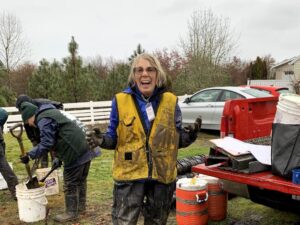
This season at Friends of Trees, we will plant our millionth tree. Our millionth tree, like all of the trees and native shrubs we’ve planted, will be planted with the power of community volunteers. We’re telling their stories! Read more here.
Carolyn’s commitment to crew leading is inspired by a sense of community and fun
Carolyn is the type of Crew Leader who brings cookies to planting events on her own birthday. She has a keen sense of the big difference that small actions can make, and even more simply, believes in the importance of fun.
“It’s so much fun,” she says of crew leading. “Why would I want to do anything else?”
She learned about Friends of Trees in 2019, quickly became a Crew Leader and volunteers as often as she can, racking up almost 400 volunteer hours at dozens of events in the years since.
“It’s too easy to become isolated in this world,” she says. “I volunteer every weekend if I can. It’s the best way to stay active.”
Carolyn is an avid volunteer, and not just at Friends of Trees. “There are so many ways to be involved,” she says. “It’s what a community needs.”
With Friends of Trees, Carolyn especially loves leading crews at Green Space plantings, helping lead volunteers to enhance natural areas in urban parks by planting native trees and shrubs. She loves seeing the plants grow from year to year. And because she is so active, she gets to meet people, then remeet people.
“You start each event with: we don’t even know each other, but we are a community,” she says. “And it’s so exciting when you see people come back for another event. It makes me want to weep! There’s so much bad news out in the world, but then you see so many people who want to plant.”
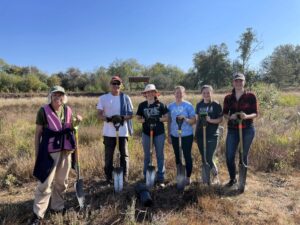
She knows it’s her job to set the tone for how the planting is going to go, especially on a chilly, wet winter day. She knows the planting sites well and she’ll often point out established plants from a previous year and tell volunteers, people just like you planted that.
“You know that anyone who is a part of a Friends of Trees event cares about trees. And people want to help. Whether it’s muddy or hard to dig, people just want to help. They love doing it.”
“Carolyn has such a calming, supportive presence,” says Jenny, the Volunteer & Outreach Program Manager at Friends of Trees. “She gives confidence to everyone she works with.”
Carolyn remembers walking to a planting event at Gateway Green with a huge group of college students on a service trip.
“They were just thrilled to be able to do this. And they’re not even from here.”
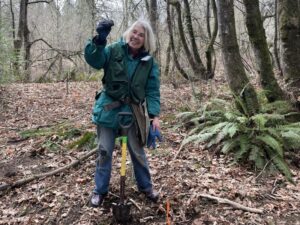
Carolyn believes that Friends of Trees Crew Leaders have a couple things in common: enthusiasm and perseverance. Carolyn certainly has these qualities in spades. Even though she has recently been sidelined from crew leading as she recovers from a surgery, she has found other ways to volunteer her time toward event prep. And she’s eager to put the vest back on and lead crews again as soon as she can.
When asked what she would say to someone considering becoming a Crew Leader, she had a simple response: “Do it. It is just so fun.”
After a planting event, she goes home, washes her muddy clothes, and enjoys the satisfaction of what she and her crew accomplished. She sees it as her role as a Crew Leader to make sure her crew feels that same satisfaction, that they’ll later feel the pull to revisit what they planted to see how it’s grown.
Carolyn sees the long term impact, the growth of both trees and community, and she knows it all starts with people simply showing up.
“Just the fact that people come,” she says, “makes every muddy day worth it.”

A Million Trees, A Million Stories is brought to you by our Presenting Partner, Portland General Electric.

New Trees Tell a New Story at the Library
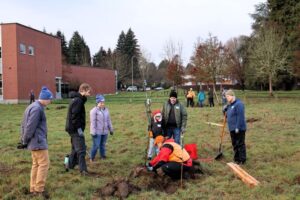
Volunteers planted a model for a climate resilient urban forest at the Tigard Public Library.
There’s nothing quite like sitting under a tree with a good book. At the Tigard Public Library, there are 20 new trees for community members to enjoy, and the species were chosen to stand the test of time.
This month, volunteers gathered on a sunny Saturday morning to plant trees in an empty field right outside their library. The Tigard library had reached out to Friends of Trees to design a planting that would serve as a model for a climate resilient urban forest. The field was once an apple orchard, but has sat empty and unused for decades.
“We can change the story of this field,” says Library Director Halsted Bernard. “We can bring in trees to remediate soil and bring in wildlife.”
“It’s a little unusual for us to plant large stock trees all in one place to serve as habitat restoration,” says Mario Catani, Friends of Trees’ Neighborhood Trees Specialist for Washington county. “These trees get to serve as an arboretum of sorts, as habitat restoration along Fanno Creek, and as a model of tree species we expect to do well in the face of climate change.”
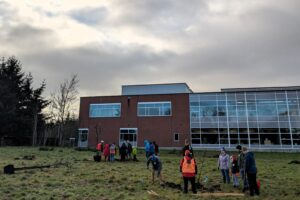
When it came to tree selection, Mario looked south. Not just to our Eugene Branch and their work planting climate trees, but all the way to California, where species like the blue oak have proved their ability to withstand extreme temperature swings. These species are used to seeing temperatures of 110 degrees Fahrenheit or more, which is becoming more and more common here.
“Especially with climate change, we need to plant with a decades-long view,” Mario says. “The trees that we plant now are going to be living in a completely different world. We’re already seeing certain species start to struggle with extreme summer heat and winter storms.”
The blue oak (Quercus douglasii) is native to Southern Oregon and California. Named for the gray-blue tint on its leaves, the blue oak is very drought tolerant. It’s a keystone species for Nuttall’s woodpeckers, nuthatches, plain titmice and so much more.
“It’s a tree we would plant more of if they were easier to source,” Mario says. “They grow anywhere from 20 to 60 feet, so I think they’d make an excellent street tree.”
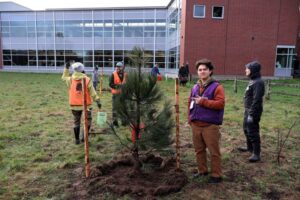
Another species volunteer planted at the library was the ponderosa pine, which is native to the region but has a huge range from New Mexico to Washington.
“Ponderosas are resilient, hardy, and fast-growing, but they’re huge,” Mario says. “Luckily, we have the space in a site like this. We should plant them whenever we can.”
Volunteers also planted coast live oaks (Quercus agrifolia, a sentimental favorite of Mario’s), incense cedars, bald cypresses, quaking aspens, and Oregon white oaks. Library patrons will be able to watch them grow, and beyond that, engage with library programming around the new forest.
“I liked that all the volunteers came from the library,” Mario says. “They’ll get to enjoy the trees that they planted and feel more connected to their space.”
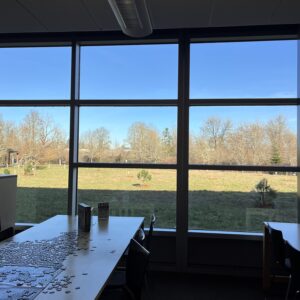
“We’re excited about the possibilities of expanding library services into our backyard, into outdoor space” says Amber Bell, the library’s Readers Services Manager.
Mario is also excited about all the ways these trees will provide for the community.
“These will be mother trees,” he says. “People can come and collect acorns and plant their own climate trees!”
Heritage Trees Have To Start Somewhere
This season at Friends of Trees, we will plant our millionth tree. Our millionth tree, like all of the trees and native shrubs we’ve planted, will be planted with the power of community volunteers. We’re telling their stories! Read more here.
Since he was a teenager, Reggie’s deep involvement with Friends of Trees has taken many forms.
Reggie’s tree planting has always been motivated by a sense of justice. When he was a teen, a neighbor convinced one of his parents to remove mature trees in their yard, leaving it barren and exposed.
“It was traumatic to walk up to the house one day and see a crane with a crowd of neighbors watching these beautiful trees be dismantled,” Reggie says. “They had provided a lot of good.”
A couple years later in 2008, Reggie volunteered for his first Friends of Trees planting event at Taliesen Park in Beaverton after seeing a posting in the newspaper.
“I suddenly had this opportunity to plant trees in my own neighborhood,” he says. “It was exciting to make a permanent, positive difference for my immediate environment.”
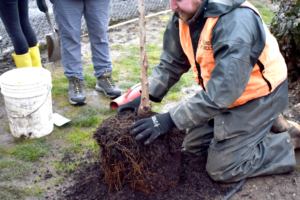
It was an Arbor Day planting event, and at the end of it, Reggie was given a 1-gallon Douglas fir to take home with him and plant where he pleased.
“That small free conifer really changed things for me. I realized, I can actually plant this at home in the yard where the trees had been and now I know how.”
After that, Reggie volunteered at Friends of Trees planting events in Beaverton whenever he could. When he went to Eugene for college, he started volunteering with the Eugene Branch.
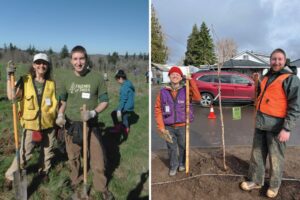
At his first event in Eugene in 2012, he remembers planting a blue oak—a species native to California that will likely do well in Oregon as the climate warms—the first ever blue oak as a street tree in Eugene.
“It was a historic moment,” Reggie says. “Where do ‘heritage trees’ start? They have to start somewhere.”
History is another huge motivator for Reggie. He has a keen sense of our place in history, looking both into the past and forward into the future.
“I grew up surrounded by large trees. Mature red maples lined my street. Those are there thanks to someone who cared enough in the 1970s. We can’t take trees for granted. Each one was only an intentional decision by someone in the past, and we get to benefit from that effort now. It’s important that we continue making those decisions in the present.”
Reggie’s passion translated into action, and a deepening involvement as he entered adulthood. During his junior year of college, Reggie became a Crew Leader and went to even more planting events. His senior year, he interned with Friends of Trees in Eugene. His first job out of college, back in the Portland area, was as a Friends of Trees outreach assistant, going door to door to encourage people to sign up to have trees planted at their homes.
“I liked talking to people, I liked being an ambassador for the work. And it was a way to get familiar with more trees and see the region through an urban forestry lens.”
In 2017, Reggie began serving what became two consecutive AmeriCorps terms with Vancouver Urban Forestry, which partners closely with Friends of Trees. He discovered a sense of community around Vancouver. Meanwhile, he grew his experience. He participated in outreach, summer inspections and neighborhood coordinating. He still participates in every Beaverton event that he can.
“All things tree-related, Reggie’s the guy,” says Mario Catani, the Friends of Trees Neighborhood Trees Specialist for Washington County. “Personally, I am super inspired by him.”
Now, Reggie is an Environmental Technician with Portland’s Bureau of Environmental Services, but he still does plenty of tree planting off the clock, with Friends of Trees in Beaverton and beyond.
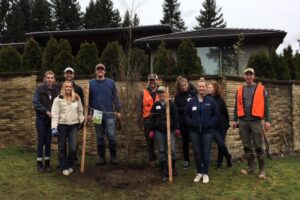
“Reggie deserves a statue in Beaverton for all of the tree work he’s done there,” says Mario. “From working with Friends of Trees to hosting his own grassroots Highland neighborhood plantings to leading Pedalpalooza rides about tree policy, he has shown how much he deeply cares about connecting people with trees.”
“The community aspect keeps me coming back,” Reggie says. “When it seems like society is crumbling and you’re feeling a little helpless, getting people together to plant trees is a healing experience. I have a whole network of people who I know want to help, people who care about our future.”
Mario was particularly inspired that Reggie took the lead on replanting trees at Beaverton City Park after trees fell in the 2024 ice storm, gathering volunteers to plant sequoias and ponderosa pines to reforest the park’s historic grove. “You could tell he wanted to heal the wounds left by the storm,” Mario says.
Ever since his first planting back in 2008, Reggie has watched those trees grow, and he has grown along with them, nurturing a passion for climate justice, community building, and an optimism for the future that is built on direct action. He hopes that more people are inspired to make the world a better place.
“If we don’t do it now, we’ll be letting down future generations.”
A Million Trees, A Million Stories is brought to you by our Presenting Partner, Portland General Electric.