
Trees & Bees? Yes Please!
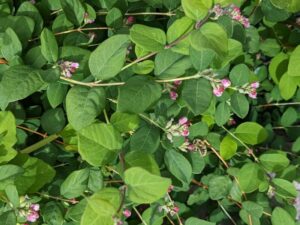
We partnered with Vancouver Bee Project to add pollinator plants alongside new neighborhood trees.
An urban tree doesn’t exist in a vacuum. As soon as it’s planted, it interacts with the soil and air, with people and wildlife. Our neighborhoods are their own ecosystems. At a recent planting in Vancouver, Friends of Trees leaned into that idea, incorporating native plants alongside new trees to attract pollinators.
We’re in our second year of partnering with a local organization, Vancouver Bee Project, to bring pollinator plants to our communities. Last season, we shared a vision to pilot a pollinator “guild” component within a planting event. This month, we had another co-planting that added 150 pollinator plants like yarrow, wild strawberry, lupine and aster alongside new neighborhood trees in the Central-North/Fourth Plain neighborhoods. We also gave away another 150 plants for volunteers to take home.
“Partnering with Friends of Trees was a natural fit because we share the same vision of creating healthier urban ecosystems,” says Kyle of Vancouver Bee Project. “Trees and pollinator-friendly plants complement each other beautifully, enhancing biodiversity and strengthening our community’s environmental health.”
“It’s great that the trees get buddy plants,” says Adela, the Friends of Trees Neighborhood Trees Specialist in Vancouver who helped organize the partnership with Vancouver Bee Project. “Trees are part of a larger ecosystem, even in an urban environment, and so are pollinators.”
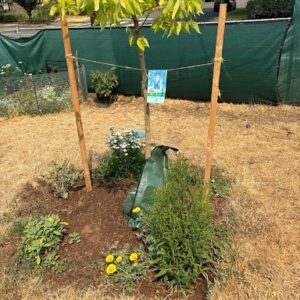
The life of an urban tree is a hard one—they are subjected to all kinds of pressure from their environment. Planting companion plants around the base of an urban tree, or creating a plant “guild,” creates the opportunity for synergetic plant relationships: Plants provide the tree with extra nutrients and trunk protection, and the tree provides plants needed shade and support. These guilds also provide high quality forage and habitat for native pollinators, who could really use our support.
“When I inspected the trees we planted last season this past summer, it was so exciting to see how these little plants took off,” Adela says. “Each tree with a guild was buzzing with bumblebees, and I even saw a butterfly or two.”
Vancouver Bee Project and Friends of Trees selected the Central-North/Fourth Plain neighborhoods to pilot this initiative. We wanted to make the social, ecological, and aesthetic benefits of these plants available to a part of the Vancouver community that experiences high health disparities and includes historically underserved communities.
“Volunteers were so excited about adding pollinator plants,” Adela says. “Neighbors in this area were so on board and happy to help. Everyone who received a tree also participated in the planting in some way.”
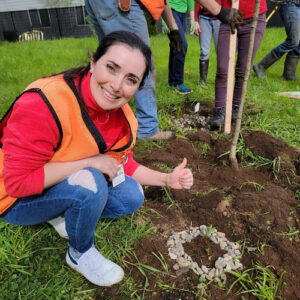
Vancouver Bee Project joined in at the crew leader huddle to demonstrate proper planting, and crew leaders reported that it was a positive and easy addition to the planting day.
“The event was fantastic,” Kyle says. “There was a palpable excitement among volunteers as we introduced pollinator plants alongside the trees. People loved learning about how these plants directly support local bees, butterflies, and birds.”
These plants will serve to maximize urban pollinator habitat connectivity—these little havens along our streets and in our yards help pollinators move throughout the urban landscape. Our native pollinators are increasingly threatened by human caused changes in the environment, such as climate change and habitat loss from development, so helping them out in these ways, by providing refuge and forage, can make a huge difference.
“As a kid, I only thought of bees as something that could sting me,” Adela says. “One time I sat on one! Now I recognize them as super important. Now there’s a unique joy when I find a pollinator guild buzzing with bees.”
Friends of Trees hopes to make this partnership with Vancouver Bee Project a fixture of future seasons, and to continue to think about how we can care for our pollinators throughout our programming.
“By protecting pollinators, tree lovers support the overall health and sustainability of our urban forests and community green spaces,” Kyle says.
“To expand what we can offer our communities and our ecosystem at large, and to dream up new possibilities—How exciting is that!” Adela says.
Check out all the fantastic work Vancouver Bee Project is doing! Vancouver, WA, is on its way to receiving a Bee City USA designation – learn more about that here.