
Tag: pollinators
Trees & Bees? Yes Please!
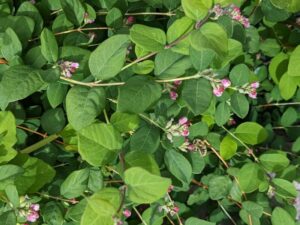
We partnered with Vancouver Bee Project to add pollinator plants alongside new neighborhood trees.
An urban tree doesn’t exist in a vacuum. As soon as it’s planted, it interacts with the soil and air, with people and wildlife. Our neighborhoods are their own ecosystems. At a recent planting in Vancouver, Friends of Trees leaned into that idea, incorporating native plants alongside new trees to attract pollinators.
We’re in our second year of partnering with a local organization, Vancouver Bee Project, to bring pollinator plants to our communities. Last season, we shared a vision to pilot a pollinator “guild” component within a planting event. This month, we had another co-planting that added 150 pollinator plants like yarrow, wild strawberry, lupine and aster alongside new neighborhood trees in the Central-North/Fourth Plain neighborhoods. We also gave away another 150 plants for volunteers to take home.
“Partnering with Friends of Trees was a natural fit because we share the same vision of creating healthier urban ecosystems,” says Kyle of Vancouver Bee Project. “Trees and pollinator-friendly plants complement each other beautifully, enhancing biodiversity and strengthening our community’s environmental health.”
“It’s great that the trees get buddy plants,” says Adela, the Friends of Trees Neighborhood Trees Specialist in Vancouver who helped organize the partnership with Vancouver Bee Project. “Trees are part of a larger ecosystem, even in an urban environment, and so are pollinators.”
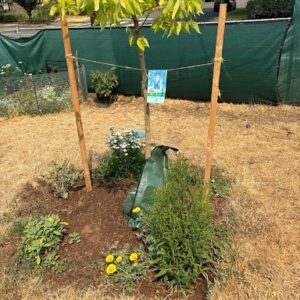
The life of an urban tree is a hard one—they are subjected to all kinds of pressure from their environment. Planting companion plants around the base of an urban tree, or creating a plant “guild,” creates the opportunity for synergetic plant relationships: Plants provide the tree with extra nutrients and trunk protection, and the tree provides plants needed shade and support. These guilds also provide high quality forage and habitat for native pollinators, who could really use our support.
“When I inspected the trees we planted last season this past summer, it was so exciting to see how these little plants took off,” Adela says. “Each tree with a guild was buzzing with bumblebees, and I even saw a butterfly or two.”
Vancouver Bee Project and Friends of Trees selected the Central-North/Fourth Plain neighborhoods to pilot this initiative. We wanted to make the social, ecological, and aesthetic benefits of these plants available to a part of the Vancouver community that experiences high health disparities and includes historically underserved communities.
“Volunteers were so excited about adding pollinator plants,” Adela says. “Neighbors in this area were so on board and happy to help. Everyone who received a tree also participated in the planting in some way.”
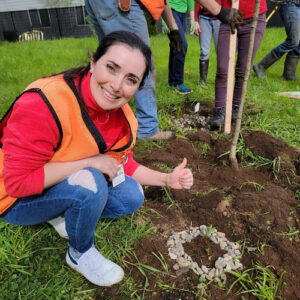
Vancouver Bee Project joined in at the crew leader huddle to demonstrate proper planting, and crew leaders reported that it was a positive and easy addition to the planting day.
“The event was fantastic,” Kyle says. “There was a palpable excitement among volunteers as we introduced pollinator plants alongside the trees. People loved learning about how these plants directly support local bees, butterflies, and birds.”
These plants will serve to maximize urban pollinator habitat connectivity—these little havens along our streets and in our yards help pollinators move throughout the urban landscape. Our native pollinators are increasingly threatened by human caused changes in the environment, such as climate change and habitat loss from development, so helping them out in these ways, by providing refuge and forage, can make a huge difference.
“As a kid, I only thought of bees as something that could sting me,” Adela says. “One time I sat on one! Now I recognize them as super important. Now there’s a unique joy when I find a pollinator guild buzzing with bees.”
Friends of Trees hopes to make this partnership with Vancouver Bee Project a fixture of future seasons, and to continue to think about how we can care for our pollinators throughout our programming.
“By protecting pollinators, tree lovers support the overall health and sustainability of our urban forests and community green spaces,” Kyle says.
“To expand what we can offer our communities and our ecosystem at large, and to dream up new possibilities—How exciting is that!” Adela says.
Check out all the fantastic work Vancouver Bee Project is doing! Vancouver, WA, is on its way to receiving a Bee City USA designation – learn more about that here.
Friends of Trees, Friends of Bees
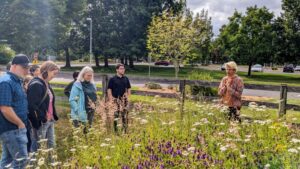
How we can plant to promote native pollinators
Next time you see a bee buzzing around your garden, take a closer look. It’s cute, right? And on top of that, it’s performing a very important ecological process—pollination!
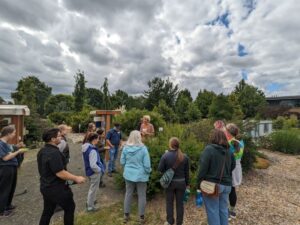
Last month we hosted two pollinator workshops in Washington county during National Pollinator Week, thanks to funding from the Tualatin Soil and Water Conservation District. Folks gathered at the PCC Rock Creek Learning Garden and at Tualatin River National Wildlife Refuge to take a tour of pollinator-friendly plants, learn what makes for good pollinator habitat, and to spot some native bees along the way. Friends of Trees staff shared their knowledge on the topic and led activities to guide people in designing their own pollinator gardens.
What is a pollinator? Pollinators are animals (mostly insects) that move pollen from a flower’s male part to its female part in their search for sustenance, making that plant’s reproduction possible. This process makes pollinators a really key part of both agricultural and ecological systems. 35% of our food sources and 75% of flowering plants depend on pollinators.
“Unfortunately, we’re seeing a massive, unprecedented decline in native bees and other pollinators,” says Thomas Meinzen, a Neighborhood Trees Specialist at Friend of Trees who studied pollinator ecology and conservation in graduate school. In some countries, studies have shown more than 75% decline in insect biomass in 30 years. Because pollinators are relatively understudied, the impacts and ramifications of this decline are not fully understood.
“There are a lot of contributing factors, including pesticide and herbicide use, grazing practices, agricultural monocultures, habitat loss and climate change,” Thomas says. “It’s scary, but there are still things we can do.”
IN OUR OWN BACKYARDS
We can create habitat in our own backyards and parks. Luckily, we don’t need entire wilderness areas for pollinators to live in. You can help by planting a variety of flowering plants to provide food for pollinators from spring all the way into fall.
“Trees are particularly helpful here because they flower earlier in the year than most smaller flowering plants, providing food for early-season pollinators like bumble bees,” Thomas says. “Trees like California buckeye, cascara, hawthorns, willows, and fruit trees are all great options for native pollinators.”
It’s also best to cultivate a diversity of flower shapes, colors, and types to attract a diverse array of pollinators. Bees, butterflies, and flies are all pollinating insects looking for different types of food.
NATIVE PLANTS FOR NATIVE POLLINATORS
It makes sense that native pollinators are attracted to native plants. Our Green Space program enhances natural areas by planting many thousands of native shrubs and plants each planting season, improving air and water quality and creating habitat for wildlife, including pollinators.
“A lot of our Green Space plantings are designed to improve water quality in particular,” says Kaitie, a Green Space specialist. “But these plants are great for pollinators, which is more than just an added bonus.”
Plants like red-flowering currant and Oregon grape are common at our Green Space plantings and favorites for pollinators. Our Green Space plantings also leave open ground where bees can nest.
Many people express concern for honeybees, not realizing that honeybees come from Europe and can potentially outcompete native bee species. There are over 4,000 native bee species in the United States and over 650 in Oregon.
“There’s a lot of growing interest in pollinators,” Thomas says. “It was exciting to see that at our pollinator workshops with great turnout, in-depth conversations, and the chance to send folks home with pollinator plants.”
The best things we can do to protect and promote native pollinators are to avoid using pesticides and herbicides on our properties, plant flowers and native plants, and leave things a little messy so that pollinators can make themselves at home in our gardens.