
New Trees Tell a New Story at the Library
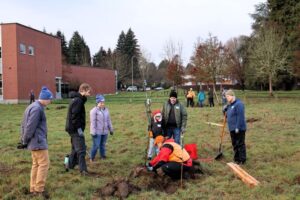
Volunteers planted a model for a climate resilient urban forest at the Tigard Public Library.
There’s nothing quite like sitting under a tree with a good book. At the Tigard Public Library, there are 20 new trees for community members to enjoy, and the species were chosen to stand the test of time.
This month, volunteers gathered on a sunny Saturday morning to plant trees in an empty field right outside their library. The Tigard library had reached out to Friends of Trees to design a planting that would serve as a model for a climate resilient urban forest. The field was once an apple orchard, but has sat empty and unused for decades.
“We can change the story of this field,” says Library Director Halsted Bernard. “We can bring in trees to remediate soil and bring in wildlife.”
“It’s a little unusual for us to plant large stock trees all in one place to serve as habitat restoration,” says Mario Catani, Friends of Trees’ Neighborhood Trees Specialist for Washington county. “These trees get to serve as an arboretum of sorts, as habitat restoration along Fanno Creek, and as a model of tree species we expect to do well in the face of climate change.”
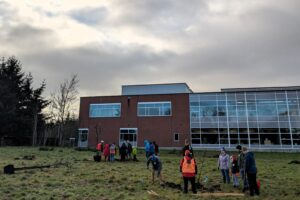
When it came to tree selection, Mario looked south. Not just to our Eugene Branch and their work planting climate trees, but all the way to California, where species like the blue oak have proved their ability to withstand extreme temperature swings. These species are used to seeing temperatures of 110 degrees Fahrenheit or more, which is becoming more and more common here.
“Especially with climate change, we need to plant with a decades-long view,” Mario says. “The trees that we plant now are going to be living in a completely different world. We’re already seeing certain species start to struggle with extreme summer heat and winter storms.”
The blue oak (Quercus douglasii) is native to Southern Oregon and California. Named for the gray-blue tint on its leaves, the blue oak is very drought tolerant. It’s a keystone species for Nuttall’s woodpeckers, nuthatches, plain titmice and so much more.
“It’s a tree we would plant more of if they were easier to source,” Mario says. “They grow anywhere from 20 to 60 feet, so I think they’d make an excellent street tree.”
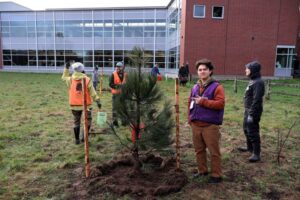
Another species volunteer planted at the library was the ponderosa pine, which is native to the region but has a huge range from New Mexico to Washington.
“Ponderosas are resilient, hardy, and fast-growing, but they’re huge,” Mario says. “Luckily, we have the space in a site like this. We should plant them whenever we can.”
Volunteers also planted coast live oaks (Quercus agrifolia, a sentimental favorite of Mario’s), incense cedars, bald cypresses, quaking aspens, and Oregon white oaks. Library patrons will be able to watch them grow, and beyond that, engage with library programming around the new forest.
“I liked that all the volunteers came from the library,” Mario says. “They’ll get to enjoy the trees that they planted and feel more connected to their space.”
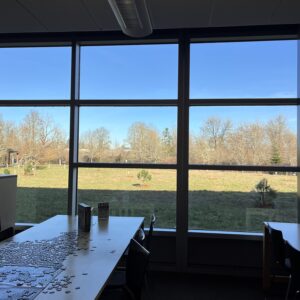
“We’re excited about the possibilities of expanding library services into our backyard, into outdoor space” says Amber Bell, the library’s Readers Services Manager.
Mario is also excited about all the ways these trees will provide for the community.