
Tag: Science
We are Friends of Bulbs!
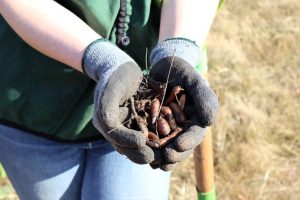
The Eugene Branch is giving away thousands of native bulbs!
Bulbs are amazing when you think about them. In the fall, you bury a little pod in your garden, and come spring it’s a beautiful flower.
“Bulbs are an underground storage organ,” says Eugene Director Erik Burke. “We’re really excited to give away thousands of them.”
On December 7th, Friends of Trees Eugene-Springfield will have a Native Bulb Giveaway event, giving away more than 10,000 native geophytes. Each person will be able to select up to 10 bulbs from a variety of native species including great camas, common camas, common milkweed, tiger lily, Wapato, Oregon checker mallow and more. Planting and care guides will be available for all attendees to take home with their new plants.
“We’re hoping people will have a lot of success with these,” Erik says.
“After they’re properly planted, they won’t need any watering, although a little the first year may help them establish.”
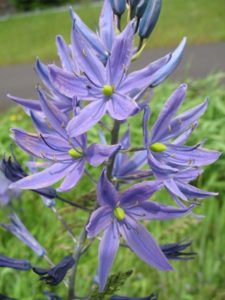
All of the species are native plants and culturally important plants, and most of them are edible! They’re great for pollinators and all have beautiful flowers, so anyone would be happy with them in their yard. We’ll be giving away mainly 3 year-old bulbs, which means they should all bloom in their first year, with the exception of camas, which may take another year.
“I like to call it a ‘geophyte giveaway,’” Erik says.
Bulbs, corms, tubers and rhizomes are all geophytes, which means they overwinter underground, using that underground storage system. A potato is an example of a root food or geophyte we are familiar with.
After seeding, these plants push all their energy into their bulbs (or corms or rhizomes) and shut down. They won’t rot in wet conditions, and can survive with little or no oxygen, making them a resilient capsule for the plant through winter. They often emerge from the ground relatively early, sometimes as early as the winter solstice or early January in the case of camas.
These plants spread really well, especially with the help of people, leading to the theory that they co-evolved with indigenous harvesting practices.
“These native plants evolved with human harvest and spread much better with human handling,” Erik says. For example, camas harvest increases camas patches by breaking off bulblets and knocking seeds into freshly disturbing soil. Harvesting also keeps the bulbs from pulling themselves too deep and the patch dying out. Camas patches really benefit from careful harvesting.
Thanks to our partners: Upper Willamette Soil and Water Conservation District and International Paper.
The Lifesaving Potential of Trees
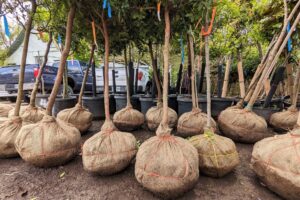
A new scientific study associates tree planting with fewer deaths
At Friends of Trees, we champion the many benefits of urban trees: they clean the air and water, provide wildlife habitat, and shade our homes and streets. Trees improve our environment, but they also improve our quality of life. Dr. Geoffrey Donovan, a researcher with the United States Forest Service, wanted to investigate one step further — do trees save lives?
In 2013, Donovan conducted a study that associated a loss of trees from emerald ash borer with a higher rate of mortality for people that lived in those places that lost trees.
“I wanted to see if the inverse was true,” Donovan says. “Would planting more trees be associated with fewer deaths?”
Luckily, Donovan had access to years worth of tree planting data from Friends of Trees. Specifically, he used the planting data from the nearly 50,000 trees that Friends of Trees planted in Portland neighborhoods since 1990.
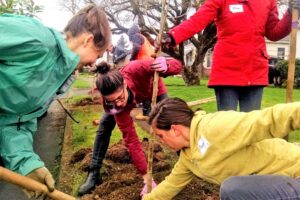
The new study, published in December 2022 in the journal Environmental International, found that each tree planted was associated with significant reductions in non-accidental and cardiovascular mortality. To account for other possible explanations for the mortality rate like race, education, and income, the statistical models incorporated data from the American Community Survey.
Looking at all 140 census tracts in Portland, Donovan showed that on average, 11.7 new trees in each neighborhood were associated with 15.6 fewer non-accidental deaths and five fewer cardiovascular deaths each year.
“It’s incredible,” says Friends of Trees Executive Director Yashar Vasef. “We know that trees can transform a community, but it’s really meaningful to see the data analysis.”
As the trees mature, their benefit grows too. Trees planted within the past 11-15 years had twice the impact of trees planted within the last five.
“The association is unequivocal, but the study has its limitations,” Donovan says. The study stops short of proving a definitive causal relationship between planting trees and fewer deaths, but Donovan expressed confidence in his findings, saying, “we do think it’s likely that trees are saving lives in Portland, because we accounted for a lot of other explanations.”
One way the study was able to account for other explanations was by focusing on the change in trees compared to the change in mortality rate. The totality of canopy can vary widely by neighborhood, but each new tree can make a difference regardless of where it’s planted.
The study went on to associate the reduced death rate with an incredible economic benefit, based on the EPA’s statistical value of a human life. Planting one tree in each of the 140 census tracts in Portland is associated with a reduction in non-accidental death of 1.33, which has a statistical value of $14.2 million. To plant and care for those 140 trees would cost just $3,000-$13,000.
“In short, trees are cheap and human lives are valuable,” Donovan says. “The public money that went to Friends of Trees generated remarkable rates of return.”
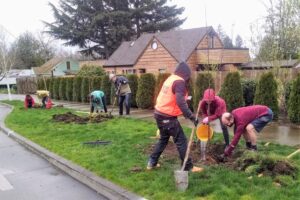
The City of Portland’s Bureau of Environmental Services did not renew its partnership with Friends of Trees that added 40,000 street and yard trees in Portland over 14 years. Friends of Trees is still planting in Northeast Portland as part of the Clean Air Canopy project, and in 17 municipalities throughout Western Oregon and Southwest Washington.
“Beyond the incredible findings, this study points to the importance of robust data collection,” Yashar says. “By diligently tracking this information, we are creating huge data sets that scientists can use in their research. And then that research can help us do our work better.” Friends of Trees logs the location, species, and planting date of every tree it plants.
“Friends of Trees data has been enormously helpful to me,” Donovan says. “I would love to see even closer collaboration between practitioners and scientists.”