
Author: Kathy Armstrong
WE’RE HIRING! Director of Finance and Operations
TITLE: Director of Finance and Operations
Applications accepted through Sunday, October 19, 11:59 p.m.; rolling application review. Full application details below.
EMPLOYMENT STATUS: Salaried. Exempt from overtime.
HOURS: 32 hours per week (0.8 FTE)
SUPERVISED BY: Executive Director
PAY RATE: Annual salary set at $68,600. Eligible for full benefits package, including 100% employer paid medical, dental and vision insurance, retirement match up to 2%, paid time off starting at 3 weeks’ vacation, 11 holidays, and sick time. The organization will be closed during the final week of December.
LOCATION: Friends of Trees Portland office at 3117 NE MLK Jr. Blvd, Portland, OR 97212. Stairs required to access office. Travel throughout the Portland Metro area with FOT provided vehicles. Work a combination of in-office and hybrid/remote.
EXPECTED START DATE: As soon as possible
ABOUT FRIENDS OF TREES
Since 1989, Friends of Trees (FOT) has planted a million trees and native shrubs in 120+ neighborhoods in six counties across two states. We’ve done this through engaging tens of thousands of community members, and while implementing and growing programming that aims to do this work inclusively and equitably. We plant trees, and so much more.
JOB SUMMARY
The Director of Finance and Operations (DFO) is a key member of the senior leadership team at Friends of Trees (FOT), reporting directly to the Executive Director. This position provides strategic direction and hands-on leadership in finance, operations, human resources, and administration. The DFO ensures organizational sustainability by aligning systems, people, and processes with FOT’s mission and long-term goals.
Core Responsibilities
Financial Leadership
- Lead all financial functions including budgeting, forecasting, reporting, compliance, and cash flow management.
- Prepare and present accurate monthly, quarterly, and annual financial reports to the Executive Director, Finance Committee, and Board.
- Coordinate and oversee the annual audit and 990 filings; act as primary liaison with auditors and external accounting partners.
- Monitor restricted grant expenditures for compliance and assist with contract invoicing, ensuring alignment with funder requirements and internal controls.
- Oversee the development and implementation of financial systems, processes, and policies to improve efficiency and transparency.
- Maintain budget planning process in collaboration with senior staff and ensure timely budget monitoring throughout the year.
- Supervise financial operations including AP/AR, payroll, credit card reconciliation, and banking activities.
Operations Management
- Oversee daily organizational operations and administrative systems to ensure they are efficient, scalable, and mission-aligned.
- Develop and enforce internal policies, performance standards, and operational procedures.
- Lead procurement and vendor management to ensure cost-effective, sustainable practices.
- Manage and administer organizational insurance policies.
- Ensure compliance with legal, financial, and organizational regulations and standards.
- Collaborate with Directors and Program Managers to streamline workflows and monitor operational needs.
Human Resources & Organizational Culture
- Assist with HR functions including, onboarding, staff benefits, and personnel records.
- Ensure consistent and equitable application of HR policies and compliance with employment laws.
- Champion an inclusive, respectful, and productive workplace culture aligned with FOT’s values.
Technology and Administration
- Lead the integration of financial technology systems that support data integrity, internal communication, and workflow automation.
- In addition to primary responsibilities, collaborate with the Systems position to deliver technology support across the organization, including laptops, phone systems, and related technologies.
- Oversee digital tools and platforms used across departments (payroll systems and financial software).
- Maintain corporate and governance records, filings, and compliance documentation.
Leadership & Strategic Support
- Serve as a key advisor to the Executive Director and Finance Committee on financial and operational matters.
- Provide high-level administrative and operational support to program staff and board members.
- Contribute to long-term strategic planning and organizational growth initiatives.
- Represent the organization in external partnerships related to finance, HR, or operations.
Other Duties
- Perform other duties as assigned by the Executive Director in alignment with the scope of this position.
Note: This job description outlines the general responsibilities of the role and is subject to periodic review and revision in collaboration with the employee during the annual performance evaluation process.
TO APPLY:
Please submit a cover letter and resume to Yashar Vasef at [email protected] by 11:59pm on Sunday, October 19, 2025. We are seeking to fill this position quickly; review of applications will be rolling until the position is filled.
In the cover letter, please address why you’re interested in this position, your personal or professional experience with equity, diversity and inclusion work, plus any relevant skills and experience not listed in your resume or benefiting from further explanation. Please limit your application materials to two pages total. References may be requested at a later date.
Friends of Trees recognizes that not everyone has equal access to the benefits of trees and healthy urban green spaces based on racial and socioeconomic status, and we are committed to building a culturally diverse and inclusive environment. Candidates of color are strongly encouraged to apply.
Friend of Trees provides equal employment opportunities (EEO) to all employees and applicants for employment without regard to race, color, religion, gender, sexual orientation, gender identification, national origin, age, disability or genetics.
A MILLION STORIES
A MILLION TREES, A MILLION STORIES
This season at Friends of Trees, we will plant our millionth tree. Our millionth tree, like all of the trees and native shrubs we’ve planted, will be planted with the power of community volunteers.
We hope you’ll join us in celebrating! You can volunteer at one of our many planting events, join us at a special millionth tree event (tree walks, tree talks, treevia, and more!), make a donation in honor of our millionth tree, or tell your own story about what trees mean to you.

Come for the Trees, Stay for the People
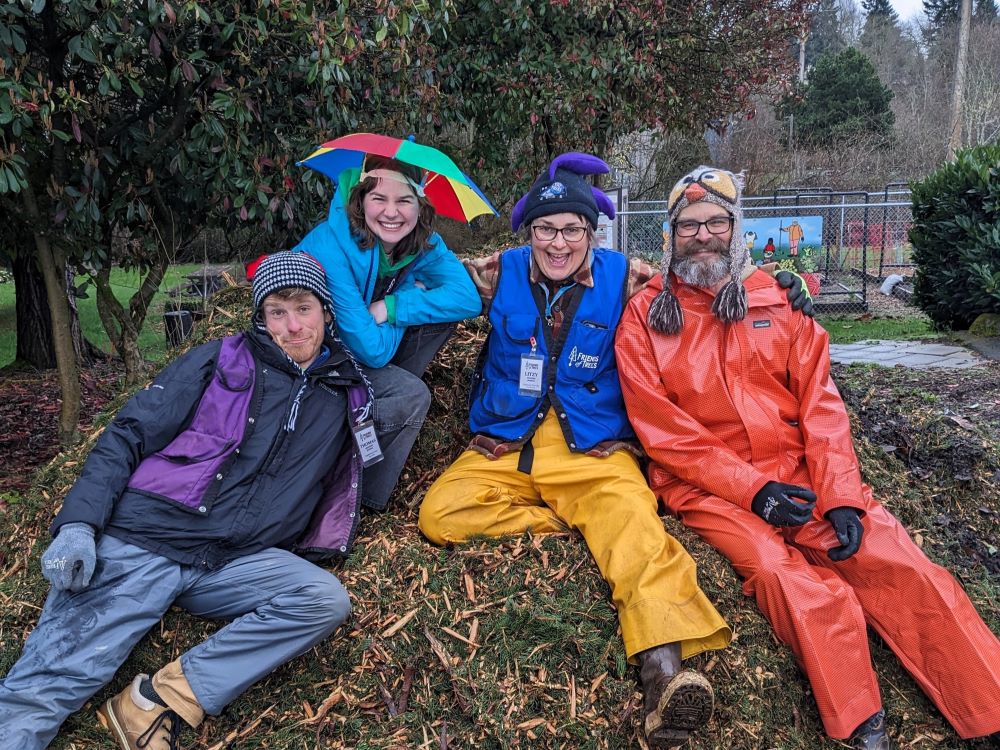
Reflections from the Friends of Trees Staff
Hi there, I’m Colin. I’m the person who puts together these stories. You might have met me at an event, or seen a glimpse of me in a social media post, but for the most part I like to step back and let other people shine. As the Friends of Trees communications manager, I see it as my job to amplify other people’s voices.
My favorite thing about that is getting to talk to people. Everyone has a story. I asked our staff to contribute their own stories, to reflect on their time at Friends of Trees, to show our audience a little more of some of the people who have helped us reach the milestone of a million trees and native plants.
Why am I stepping (briefly) out from behind the curtain? Well, I figured it’s only fair, I can’t just write an anonymous little intro for this one. I also wanted to tell you all, as Colin, that our staff is a truly special group of people. The passion you see is not a performance—they truly, deeply care about bringing people together to make their community a better place. And for all the staff members you meet out in the world, there are more behind the scenes who care just as much.
Talking to my teammates for this project has been one of the highlights of my own time at Friends of Trees and I’m so excited to share their inspiring words with you. Find all the wisdom, nostalgia, humor, and more here.
How To Do The Tree Dance
Volunteer crew leader Shay Snyder knows that climate action should be fun and inclusive.
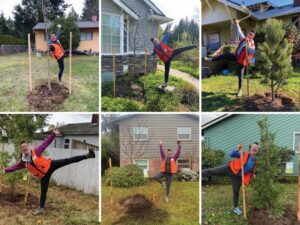
When Shay’s crew finishes planting a tree, they encourage the whole crew to do a tree dance in celebration.
“The tree dance? I’m obsessed with it,” they say. “One thing I’ve learned from teaching adults is that they don’t have many chances to feel like a kid. And we’re playing in the dirt, we can feel like a kid.”
Shay teaches college success at Portland State University and believes their classroom management skills help them be a confident and engaging crew leader at Friends of Trees neighborhood tree plantings. They strive to achieve the balance of creating a fun atmosphere and accomplishing something meaningful. Doing something tangible was what drew Shay to Friends of Trees in 2021.
“I was feeling really stressed about climate change…Why did I say that in the past tense? I am really stressed about climate change. But it feels better to do something about it.”
Shay doesn’t think they ever planted a tree before volunteering with Friends of Trees, but didn’t let that hold them back.
“I’m definitely not a tree expert. But just because I’m not a botanist or a biologist doesn’t mean I can’t contribute. I just learned how to plant a tree. Almost anyone can dig in the dirt.”
Friends of Trees strives to create inclusive planting events. Anyone can come, regardless of their background or experience. Shay loves that planting events bring together lots of people who care about trees.
“You get to meet people you’re unlikely to meet otherwise,” they say. “There’s something so special about a group of people spending four hours together and accomplishing something. And maybe you never see them again, and that’s okay.” For Shay, those connections are powerful, and a model for climate action that also bridges divides between people.
Read more of Shay’s story here. Oh yeah, and you want to know how to do a Tree Dance? Just plant a tree. And dance. Together.
Every Muddy Day Is Worth It
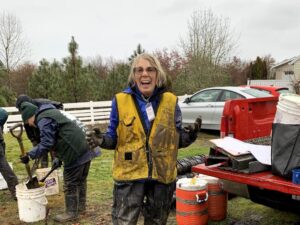
Carolyn’s commitment to crew leading is inspired by a sense of community and fun
Carolyn is the type of Crew Leader who brings cookies to planting events on her own birthday. She has a keen sense of the big difference that small actions can make, and even more simply, believes in the importance of fun.
“It’s so much fun,” she says of crew leading. “Why would I want to do anything else?”
She learned about Friends of Trees in 2019, quickly became a Crew Leader and volunteers as often as she can, racking up almost 400 volunteer hours at dozens of events in the years since.
“It’s too easy to become isolated in this world,” she says. “I volunteer every weekend if I can. It’s the best way to stay active.”
Carolyn especially loves leading crews at Green Space plantings, enhancing natural areas in urban parks. She loves seeing the plants grow from year to year. And because she is so active, she gets to meet people, then remeet people.
“You start each event with: we don’t even know each other, but we are a community,” she says. “And it’s so exciting when you see people come back for another event. It makes me want to weep!”
After a planting event, she goes home, washes her muddy clothes, and enjoys the satisfaction of what she and her crew accomplished. She sees it as her role as a Crew Leader to make sure her crew feels that same satisfaction, that they’ll later feel the pull to revisit what they planted to see how it’s grown. Carolyn sees the long term impact, the growth of both trees and community, and she knows it all starts with people simply showing up.
“Just the fact that people come,” she says, “makes every muddy day worth it.”
When asked what she would say to someone considering becoming a Crew Leader, she had a simple response: “Do it. It is just so fun.”
Read more of Carolyn’s story here.
Heritage Trees Have To Start Somewhere
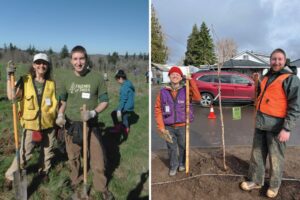
Since he was a teenager, Reggie’s deep involvement with Friends of Trees has taken many forms.
Reggie’s tree planting has always been motivated by a sense of justice. When he was a teen, a neighbor convinced one of his parents to remove mature trees in their yard, leaving it barren and exposed.
“It was traumatic to walk up to the house one day and see a crane with a crowd of neighbors watching these beautiful trees be dismantled,” Reggie says. “They had provided a lot of good.”
A couple years later in 2008, Reggie volunteered for his first Friends of Trees planting event at Taliesen Park in Beaverton after seeing a posting in the newspaper. It was an Arbor Day planting event, and at the end of it, Reggie was given a 1-gallon Douglas fir to take home with him and plant where he pleased.
“That small free conifer really changed things for me. I realized, I can actually plant this at home in the yard where the trees had been. And now I know how.”
After that, Reggie volunteered at Friends of Trees planting events in Beaverton whenever he could. When he went to Eugene for college, he started volunteering with the Eugene Branch. At his first event in Eugene in 2012, he remembers planting a blue oak—a species native to California that will likely do well in Oregon as the climate warms—the first ever blue oak as a street tree in Eugene.
“It was a historic moment,” Reggie says. “Where do ‘heritage trees’ start? They have to start somewhere.”
During his junior year of college, Reggie became a Crew Leader and went to even more planting events. His senior year, he interned with Friends of Trees in Eugene. His first job out of college, back in the Portland area, was as a Friends of Trees outreach assistant, going door to door to encourage people to sign up to have trees planted at their homes.
He still participates in every Beaverton event that he can. Read more of his Friends of Trees story here.
“All things tree-related, Reggie’s the guy,” says Mario Catani, the Friends of Trees Neighborhood Trees Specialist for Washington County.” Personally, I am super inspired by him.”
Nature as a refuge and a career path for Black youth
“I know the healing properties of nature and I’ve seen kids not benefit from that, not have access to that.”
When Jason was growing up in the suburbs of Portland, nature was his refuge.
“Growing up Black in the ‘80s, the suburbs were really racist,” Jason says. “I was harassed by police all the time. Teachers discounted me. We had a wooded area in our backyard, and the West Hills were still undeveloped. I would go outside to find peace and healing.”
This is a lesson that Jason Stroman has carried with him into his work at the Blueprint Foundation, which he helped found in 2015 to address large disparities in high school retention and graduation rates for Black students in Portland’s Public high schools. What began as a mentorship program has evolved to include a workforce training program, giving students experience and exposure to career paths in the environmental field.
After Blueprint was founded, they were looking for partners that made sense and could provide hands-on learning opportunities for the kids.
“I noticed lots of Friends of Trees activity in North and Northeast Portland. It seemed like a perfect fit because the students could do work right where they live.”
The community engagement model is another crucial piece for Blueprint’s partnership with Friends of Trees.
“A planting event might be the only time our students meet their neighbors. It creates community connections that wouldn’t happen organically.”
A favorite memory of Jason’s is a planting event in the King/Albina neighborhoods, which are historically Black but have since been gentrified.
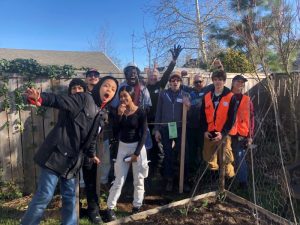
“There are still elders who live there, but fewer young people,” Jason says. Blueprint had about a dozen students in the neighborhood planting trees. An elderly Black man stopped his car to ask what they were doing.
“He hadn’t seen such a large group of young Black people in his neighborhood in a long time. He told us it gave him hope, not just for the kids, but for the community.”
Jason is also a Friends of Trees board member! Read more of his story here.
GROWING OPPORTUNITY
“It wasn’t only a big step for me. It was a change in mentality.”
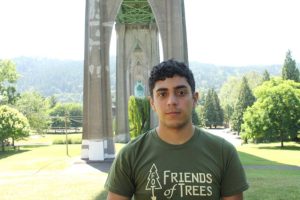
Adrián moved from Mexico City to Portland with his family and attended Portland Community College. In 2021, he got an internship with Friends of Trees through Project Zero, PGE’s social impact initiative committed to engaging the next generation in climate science learning, clean energy solutions and jobs in the green economy.
Through his internship, Adrián learned to plant and care for trees and green spaces, while also connecting with the community and charting a new career path.
“Friends of Trees is not all about planting trees. The other 50% is building community.”
For Adrián, building community is also about fighting climate change and fostering climate justice through planting trees in communities that have been historically underserved and have far fewer trees.
Watch the video below to learn about his journey and plans for the future.
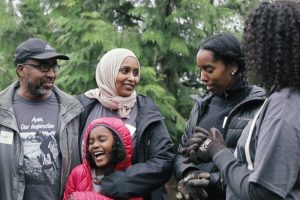
FOR AYAN
“When I think of trees, I think of resilience.”
Mohamed and Farah moved from Somalia to Portland in 1995, where they raised their six children. In 2014, their daughter Ayan, a freshman at Pacific University, tragically passed away in a car accident. Mohamed and Farah, wanting to do something as a family to commemorate Ayan, joined Friends of Trees to plant trees in her memory.
“It was bringing us together as a family in one place for a cause,” Mohamed says. “That was really healing for us as a family.”
Attending planting events became a beloved family tradition, and they went on to plant hundreds of native trees and shrubs together.
“Every tree that we plant, I feel like it’s for her,” Farah says. “And I think about all the benefits that all these trees will produce an I feel like that is a continuous charity that keeps giving. That gives me a way to share her with the whole world.”
Watch the video below to hear their story.
A Million Trees, A Million Stories is brought to you by our Presenting Partner, Portland General Electric.

Friends of Trees in National Geographic
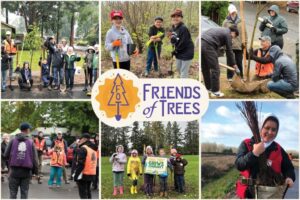
Friends of Trees’ extensive data about the trees we plant and care for was the basis for Dr. Geoffrey Donovan’s ground-breaking study about the life-saving potential of trees–and now that data and Friends of Trees are in National Geographic! (we bolded the Friends of Trees section for you)
The surprising way that millions of new trees could transform America
The U.S. is making a billion-dollar investment in planting and maintaining trees across the country to combat extreme heat and expand access to nature. But the benefits go way beyond that.
BYJEANNE DORIN MCDOWELL
When community groups planted 125 trees in two low-income neighborhoods in north central Detroit this past spring, changes were seen almost immediately. Residents began using the newly greened streets as a pedestrian corridor that allowed them to interact more with their neighbors. Trash collectors who routinely picked up garbage reported that littering had almost stopped completely.
“To me, it was validation that what we are hoping to accomplish with trees can and will work,” says Eric Candela, director of local government relations for American Forests, whose mission for more than 100 years has been to restore and protect the nation’s forest ecosystems.
In the next few months, Detroit will receive almost $10 million to plant more trees, along with many other cities and nonprofit groups in the U.S. that will get varying amounts to affect similar change. As part of the Inflation Reduction Act, the Biden Administration is awarding a billion dollars in grant money to communities throughout the country to plant trees to combat extreme heat and increase access to nature in cities and towns, where more than 84 percent of Americans live.
The money, which is the largest investment to date in urban and community forests, will go mostly to disadvantaged communities that grapple with “tree equity”—having enough trees so that everyone can experience their environmental, health, and economic benefits.
Adapting to climate change while helping fight it The positive climate impacts of trees are well-documented.
Trees, including parks and nature preserves, remove about 45 million tons of climate-warming carbon dioxide from the atmosphere each year, according to the Environmental Protection Agency (EPA). Already, they offset the pollution from about 10 million cars.
On a more local level, the can drastically influence the climate of a single neighborhood.
Trees are natural coolants and lower the risk of respiratory and heat-related illnesses such as those seen during this summer’s record heat wave. Streets with few trees are typically 10 degrees warmer and exacerbate “urban heat islands” that occur in areas with dense concentrations of pavement, concrete, and other materials that absorb and retain heat.
“Trees are a critical part of the infrastructure of cities and are as important as sidewalks and bridges,” says Benita Hussain, tree equity lead for American Forests, which was awarded $50 million in federal funding for tree planting and maintenance.
A growing body of research is finding that trees also provide an array of benefits associated with physical and mental health.
How trees make us healthier The calming effect of being around trees is familiar to anyone who has sat on a bench under a tree, walked down a tree-lined street, or experienced the respite of shade from a tree on a scorching hot day.
But research has also found that trees can help people live longer. A 2022 U.S. Forest Service study of 30 years of tree planting in Portland, Oregon by the nonprofit organization Friends of Trees found that one premature death was avoided for every 100 trees planted. Using data from the Oregon Health Authority, researchers found that in neighborhoods where more trees had been planted, death rates (per 100,000 persons) were lower. The association strengthened as trees aged and grew: the reduction in mortality rate associated with trees planted 11-15 years before was double that observed with trees planted in the preceding 1-5 years. This speaks to the potential public health benefits of preserving existing mature trees, which are associated with lower death rates.
In a 2020 report on Philadelphia’s goal to reach 30 percent tree canopy cover in every neighborhood by 2025, researchers estimated that 403 premature deaths overall, including 244 premature deaths in areas of lower socioeconomic status, could be prevented annually if the city were able to meet its goal. At the time, the tree canopy cover in disadvantaged areas was about 17 percent.
Trees make us happier too Numerous studies show that being around trees reduces blood pressure as well as the stress-related hormones cortisol and adrenaline. Research has also found that increasing the number of urban trees is associated with a statistically significant improvement in mental health conditions, especially for people living in disadvantaged areas. A 2015 study monitored participants’ heart rates to measure acute stress responses in individuals who walked past vacant lots in Philadelphia before and after they were filled with trees. They found that looking at greener lots decreased heart rate.
“Trees calm us down, improve our mood and stress levels, and lower blood pressure,” says Michelle Kondo, a U.S. Forest Service social scientist who studies the health benefits of trees.
Being in nature helps people bounce back faster from stress, and being around trees helps restore attention. It’s a mini-rest period that reduces the body’s arousal mechanism and returns it to a more restful state, thereby stabilizing mood.
“We spend so much time staring at computer screens, but being in nature allows us to replenish that cognitive reserve,” says Peter James, an environmental health expert at Harvard’s T.H. Chan School of Public Health. “Staring at trees, even watching leaves scatter in the wind allows our brains to be ready for the next cognitive task.”
Similarly, trees can help children with ADHD. Linda Powers Tomasso, an environmental scientist at the T.H. Chan School of Public Health, asserts that this is especially useful in helping children with attentional issues and that trees can help them focus more.
Transforming tree-less communities Studies confirm that planting trees fosters a sense of community and civic pride, especially in areas that have been historically underinvested in.
“Psychologically, people feel ‘someone is paying attention to my neighborhood,’” says Tomasso. ‘”Some entity cares about my neighborhood. I matter.’”
The presence of trees in urban areas facilitates outdoor recreation, physical activity, and socializing, which can reduce lonelines.
“Being near trees softens people in disposition and makes them more empathetic to others,” says Kondo.
Trees can even reduce crime and gun violence.
A recent University of Pennsylvania study examining gun violence and tree cover in six U.S. cities found that higher neighborhood income was strongly linked to lower firearm violence over a five-year period. A 2018 study on cleaning-and-greening vacant lots in neighborhoods with residents living below the poverty line found a 29 percent reduction in gun violence around lots that were greened with trees compared to vacant lots.
The process of planting and maintaining urban trees can also bring jobs to a community and lead to the creation of a local environmental workforce.
According to Marcos Trinidad, senior director of forestry for Southern California’s Tree People, which received $8 million in federal funding, upcoming tree plantings throughout parts of Southern California will require many workers—for planting new trees, pruning , and removing older trees. In fact, funding comes at a time when millions of trees are being lost to wildfires, drought, urban development, and a lack of good tree care.
“I’m not a psychologist,” adds Trinidad. “But when I’m around trees, and I can walk down a street lined with trees…, it creates this overall feeling of joy.”
TREE SALE!

CELEBRATE EARTH DAY with our Annual Shade Tree Sale!
Saturday, April 22, 10am-2pm.
Friends of Trees office, 3117 NE MLK Blvd, north parking lot
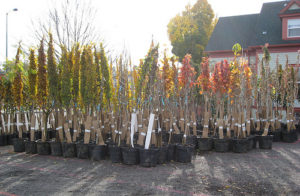
✅ Over 200 trees available, ranging from small to large
✅ Prices from $25 – $100
✅ Assistance with tree selection
✅ Loading assistance
🚫 Planting assistance 🚫 Delivery of trees 🚫 A list of tree before the event 🚫 Reserving trees before the event
Don’t miss this unique opportunity to get a quality tree at a discount!

WEIGH IN & SUPPORT MORE COMMUNITY TREE PLANTING

You can help make sure that tree planting efforts in Portland are equitable, inclusive and community-driven.
You may have heard of the Portland Clean Energy Fund (PCEF), approved by voters in November 2018. PCEF is intended to provide a consistent, long-term funding source to ensure that our community’s climate action efforts support social, economic and environmental benefits for all Portlanders, particularly communities of color and people with low incomes.
PCEF has dedicated $40 million for tree planting and tree care. The Equitable Tree Canopy Program will work in Portland’s most heat-vulnerable neighborhoods to equitably plant and establish 15,000 – 25,000 trees on public and private property.
Friends of Trees testified at City Council in support of this exciting initiative and continues to be engaged in the process, partaking in three roundtable conversations that helped inform the current draft of the Equitable Tree Canopy Program.
Right now, PCEF is looking for feedback on the working draft, which you can review here. Feedback is due by April 14, 2023 and can be made through emailing [email protected].
Friends of Trees needs your help to promote these points:
- Authentic community involvement in implementing the tree planting program. We recognize that the government, as the funding instrument, plays a role, but we know through 34 years of community tree planting that inclusive community engagement is key to ensuring buy-in and long-term success.
- Flexibility in funding language. This is a new endeavor with a lot of funds available and a very ambitious goal. It’s critical that the City and PCEF allow for language that is responsive to community needs as this program is implemented and evolves.
- Opt-in approaches for street AND yard tree planting. This means tree recipients proactively say Yes to a tree as a result of community based outreach and education. Friends of Trees knows that the opt-in method helps ensure that the trees that are planted survive and thrive because of the tree recipients’ buy-in.
- Include funding for planting yard trees. We all know the benefits that street trees provide, like shaded sidewalks and cooler neighborhoods. We also know that many folks don’t have planting strips where they can plant a street tree, but do have space for yard trees, and others really want fruit trees (which aren’t the best street trees). The more trees the better!

This is not only a historic funding opportunity, it’s a chance for the City to take giant strides toward authentic community engagement through a structure that entrusts community organizations to co-manage the tree planting funds. And we’re set up for success with a model like this: Friends of Trees and other community stakeholders such as Verde and the Jade Greening Project have successful track records with authentic community engagement, community tree planting, and collaborating to achieve common goals inclusively and equitably.
Public comment periods are your chance to have your voice heard. Join us in supporting funding for community tree planting for years to come!