Tag: workforce training
Noticing Nature

Communications intern Tony reflects on learning to prune with Friends of Trees
What I like about pruning is that when you spend time with trees, you develop a deepening of sensory experience that stays with you as you learn to recognize names and patterns in nature. It has a slowing down effect. And when looking at trees individually, you realize that each tree is full of intricate detail that reveals a mini ecosystem world.
Thanks to the Adult Urban Forestry Program, Friends of Trees has given me access to this relationship with living things that I wouldn’t otherwise have. I’m excited to one day share this with my little kids. It’s clear they love—and need—to get dirty and play with living things too. My family lives in a sixth floor apartment. We’ve tried growing things on our balcony, with limited success. We have containers of soil to scoop and dig in, and have discovered a few shade-tolerant flowers that can live up here. My brother gave me a maple tree that lives in a bucket and is leafing out in the April weather.
From six floors up, the human-made city has patterns that, like nature, can have a certain calming effect if you let your mind dilate—just try not to think about goods and services moving in a loop forever! Nature has fractal complexity in abundance, and it is slower. Ants, when observed, move goods and services in a loop forever, too. But those ants are crawling over each other and don’t seem to be taking it personally. The natural world has so much to offer when we take our time with it. You notice the rustle of leaves, the interplay of light and shadow, you touch moss and smell things.
Looking at nature can produce “Soft Fascination,” a term coined by Rachel and Stephen Kaplan, who pioneered the study of how natural environments affect psychology. Soft Fascination describes a kind of observational complexity that invites exploratory, effortless attention and open relaxed awareness. Your mind can wander through details at its own pace, noticing more and more subtlety the longer you look.
For me, pruning with Friends of Trees combines mental relaxation with problem-solving. You get this nice interplay between mental modes. When you prune, the first part is always about taking a step back, relaxing the mind, engaging the senses, and just taking the whole of the tree in. And our pruning and planting events are never about getting as much done as possible. They’re about meaningful connections with trees and with each other.
My kids are still a bit too young to join me at pruning events. For now, they explore nature through our balcony, parks, and a community garden. My four-year-old daughter is intrigued by the idea of pruning, and has requested “pruners that are the right size for kiddos.” Lately, when I pin my nametag on, she asks if I’m going to see “Friends in Trees,” (her term is far too cute for me to correct her yet!). I tell her, “one day soon, I’ll bring you with me.”
Planting Day With Better Chances
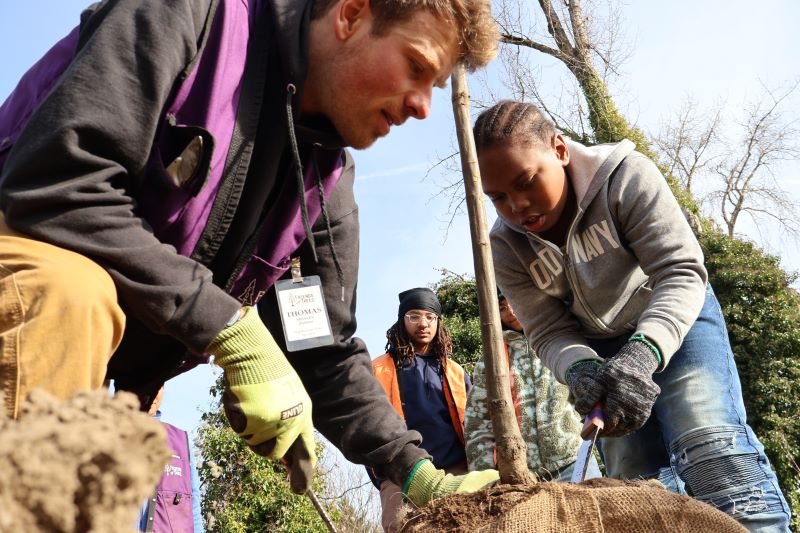
Youth plant seven trees on Marine Drive, FOT communications intern Tony S. reports
I pull into a narrow strip of land on Marine Drive in North Portland on a crisp January morning. Today we are planting seven trees with 10 BIPOC youth from the nonprofit Better Chances. We trickle in. There are going to be quite a few of us. This land will be developed into housing, and we are here to help add some extra foliage for cooling, shade, and the many benefits trees provide.
I’m here as a participant in the Adult Urban Forestry Workforce Training Program (AUF), and this is my first assignment as a communications intern. I’m joining two Friends of Trees staff and four fellow AUF graduates in leadership roles who are here to facilitate the planting.
Smoke rises from a little fire barrel. It helps to dispel some of the morning chill. A few kids in their early teens gravitate to the edge of a frozen stream nearby. They throw sticks onto the ice in hopes of a satisfying sploosh. In the clearing is a table with plenty of snacks and supplies. It’s a cozy vibe.
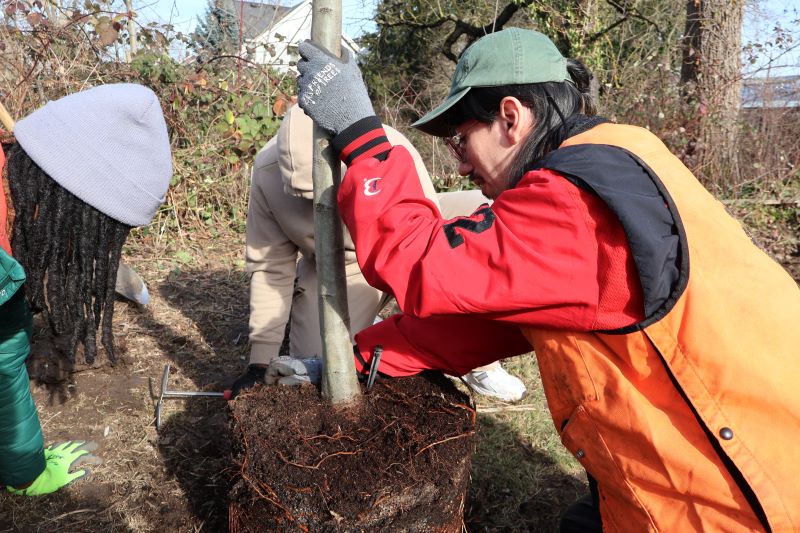
Better Chances, founded by Kadir Abdullahi and Talietha Mathis, focuses on academic support and vibrant extracurricular activities that build positive youth development. They do things such as play basketball, go to BBQ cook outs, and white-water rafting. There is focus on curiosity, play and sensory enjoyment of nature.
After a planting demonstration led by Thomas Meinzen, Neighborhood Trees Specialist with Friends of Trees, we split into groups to get some more individualized practice. We definitely have a few side quests. A frog is found and relocated to the edge of our planting area. Some holes are in the wrong spot! They need to be moved. One of our trees comes out of the pot with a tight root-bound ball. Two energetic kids step up. They put in extra effort sawing out a slice of the ball and freeing the circling roots to grow outward. Thankfully we have a lot of helping hands for our tasks.
By noon, the frost has melted in the warm mild sun, and we have most of our trees in the ground standing upright. The root-bound tree ended up chosen to be swapped for a sturdier one at a later date—a good learning example!
It is blissful to be out in nature, just playing and learning in a multigenerational group. I think there’s a real sense of ownership and placemaking in planting trees together. Housing will go up here and things will look different soon, but the trees will be here and they will accompany us through time. Over the years, these kids will be able to watch the trees they planted grow as they grow.
Thanks to everyone at Better Chances for planting with us!
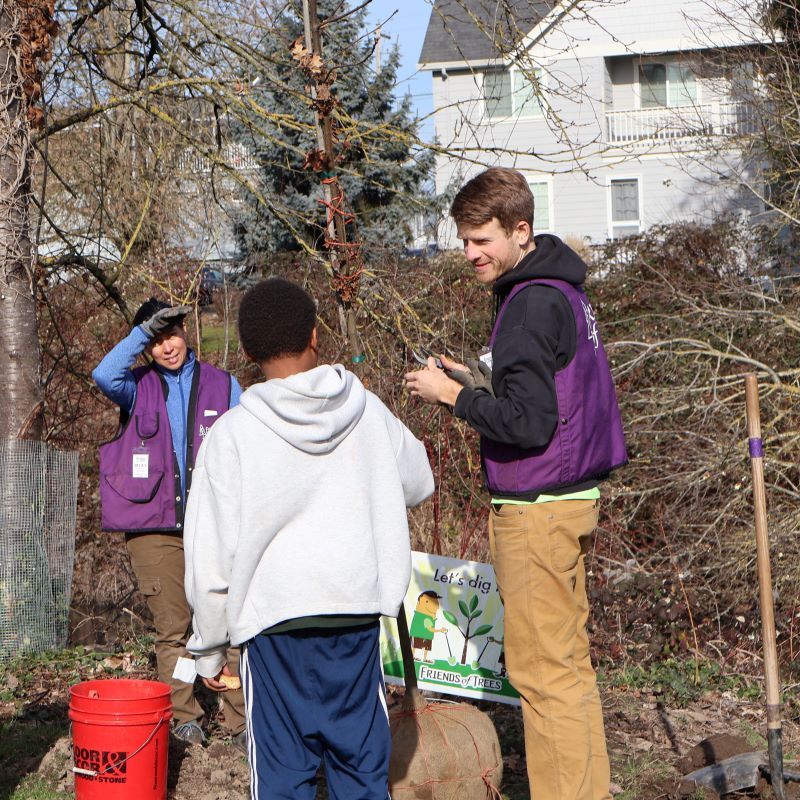
Exploring New Neighborhoods and New Skills
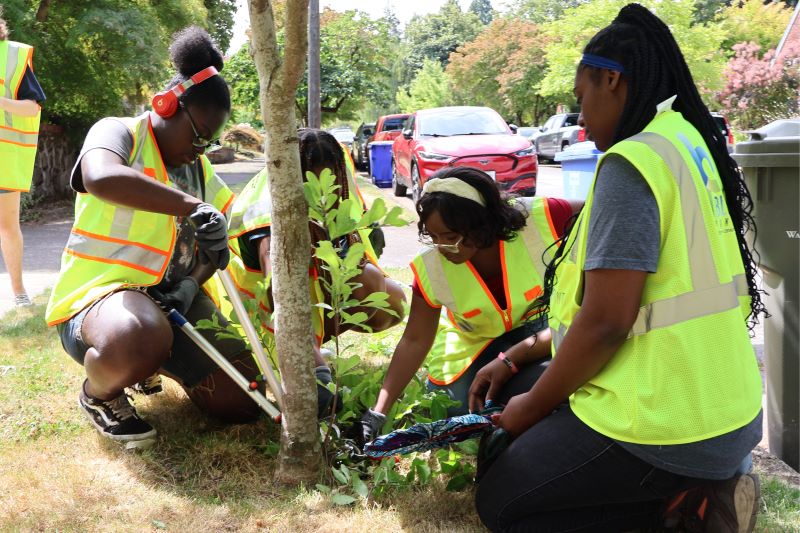
Our youth pruning program provides hands-on experience to POIC and Blueprint participants
On a Wednesday morning at Alberta Park in Northeast Portland, young folks from the Blueprint Foundation and POIC (Portland Opportunities Industrialization Center) gather for a pruning event. They’ve been doing this for a few weeks, so there’s a lovely familiarity. While they wait to start, they’re chatting with their friends, exploring the park, and enjoying the cool morning air ahead of what will be a hot day.
Eventually, we circle up, and Friends of Trees staff review the pruning process in the form of trivia, complete with gummy bear rewards. The POIC and Blueprint students really know their stuff, Quentin in particular, who earns plenty of gummy bears that he redistributes among his team. Like Quentin, many of the POIC folks have been working with Friends of Trees for a while, leading crews at planting events during the planting season.
The week before, graduates from our Adult Urban Forestry Workforce Training Program (AUF) walked through the neighborhood around Alberta Park, identifying street trees in need of pruning, and labeling those trees with a tag. This week, POIC and Blueprint students will join the AUF grads to revisit those trees, and with the guidance of a Pruning Leader or Friends of Trees staff, they’ll get out their pruners and prune those trees! This week, two AUF grads co-led a crew, a role they prepared for by attending pruning events last season.
“It’s really rewarding seeing the AUF grads step into the Pruning Leader role,” says Mario Catani, Neighborhood Trees Specialist.
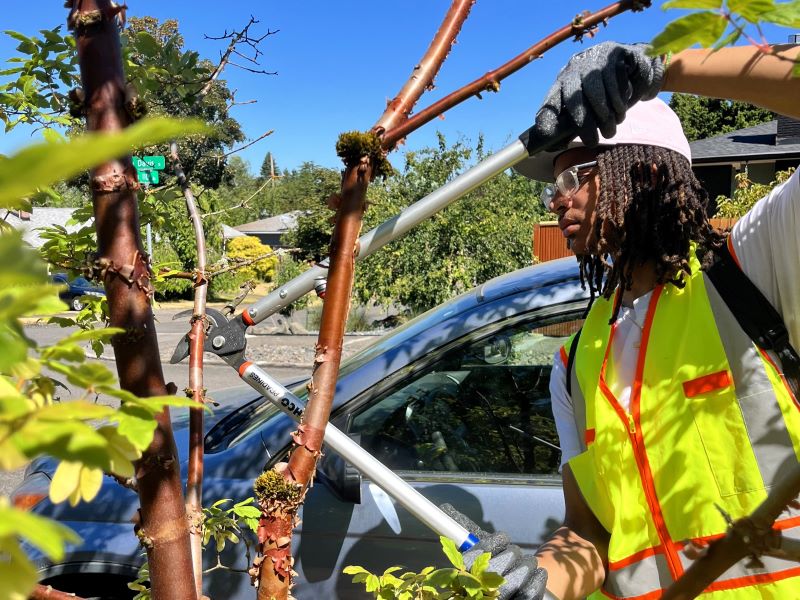
This summer has a total of four youth pruning events in North, Northeast, and East Portland neighborhoods, with funding from Metro’s Nature in Neighborhoods program. Our youth pruning program started in 2021 and has continued to evolve, with graduates from our Adult Urban Forestry Workforce Training program serving as mentors and Pruning Leaders. All the participants are paid for their time.
“It’s getting more and more intentional and meaningful each year,” says Community Tree Care Coordinator Litzy Venturi.
“This is an awesome way for us to work with Blueprint and POIC youth in the summertime,” says Workforce Development Manager Rudy Roquemore. “It’s a really cool opportunity to get to know each other in a more intimate setting.”
In this intimate setting, pruning is a collaborative effort. We split into groups and head out into the neighborhood with our list of addresses. When we locate a tagged tree, we take time to look at it and talk through the potential issues. Things like suckers, dead branches, crossing or rubbing branches, and co-dominant leaders. And together, students figure out how to address these issues in order of priority, while staying within the budget of pruning no more than 25% of the canopy.
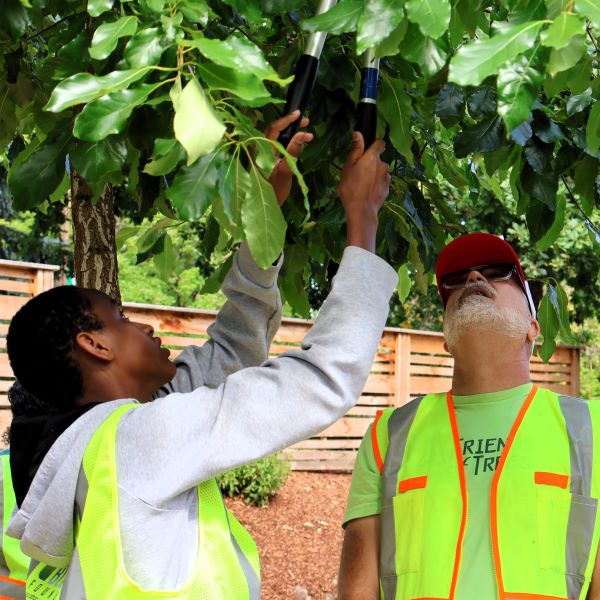
“It’s awesome to revisit some of these neighborhoods to prune trees and to introduce the youth participants to different parts of the city,” Litzy says.
Lashay Gates, a Program Assistant at Blueprint, was a program participant herself before becoming a mentor and now serving in her current position. So she knows firsthand the value of this program for the students, beyond the joy of helping a tree.
“I love working with youth and getting outside,” Lashay says. “You’re outside with more people who look like you.”
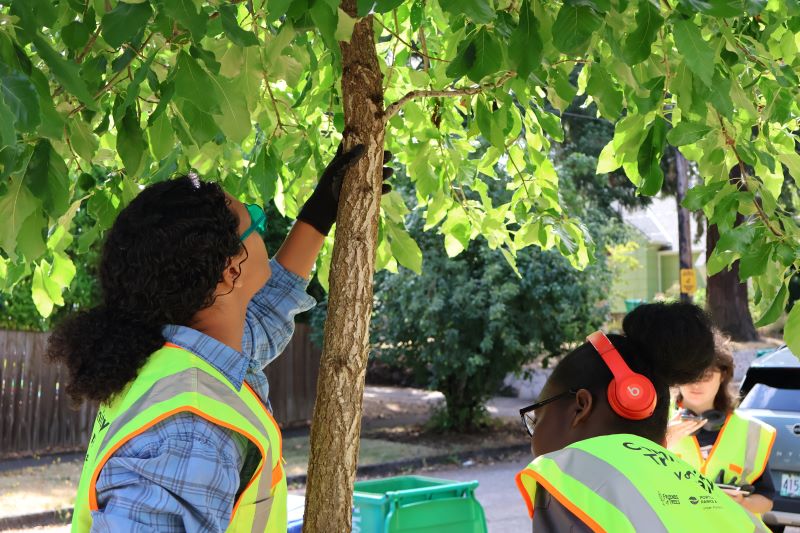
For the students, the pleasures of pruning can be simple. Being outside, learning new skills, or just the satisfaction of making a good cut that shapes the tree for future success.
“I like the cutting part,” says Aiden from POIC. “It’s very stress relieving.”
One tree down, onto the next, and after a couple quick hours and half a dozen trees, a well-earned lunch in the park.
Authentic Stories Illuminate Pathways
Updates from the Adult Urban Forestry & Restoration Training Program
For Rudy, helping people find their path into the future means reflecting on the past. Rudy Roquemore manages Friends of Trees Adult Urban Forestry Workforce Training Program, which brings together people interested in a career in the green sector.
The Adult Urban Forestry Workforce Training Program takes place in partnership with the Connecting Canopies Program, engaging adults in an urban forestry curriculum and placing them in an internship with Friends of Trees or an affiliated partner organization. The program is designed to engage underrepresented communities and address barriers to participation in the field of urban forestry. In an effort to do so, participants are paid for their time both learning and working throughout the program with the hope of creating pathways to actual jobs.
Providing pathways into the green workforce is one of the ways we can help create the next generation of responsible stewards working in our urban forests. How do we do that? One piece is exposing people to roles they can have in this line of work, and doing it in an authentic way so that people really understand their options.
The program just finished its ten-week curriculum, with each module featuring a different guest presenter and topic. Diversity of subject matter is crucial. Some things you would certainly expect, like the benefits trees provide to communities, how to plant and care for a tree, and how to identify native plants. But the curriculum goes beyond that to include things like environmental justice and financial literacy.
This is where Rudy’s approach comes in, inviting guests to share their own ethno-autobiographies to the cohort of participants.
“The simplest way to describe it is telling your story authentically—the totality of who you are and why you’re here in this moment, from your own ancestry to the places you’ve been. I want people to be as honest as possible when telling their stories. “
This honesty and authenticity gives AUF participants a more realistic sense of the pathways into the green workforce.
“Everyone has their own spin on it,” Rudy says. “There’s not actually a conventional path. These unique aspects of people’s stories allow for connections with the participants. It can really build their confidence to hear these stories.”
“It was really valuable to see people’s pathways to where they are now and the different roles in the sector,” says Air, one of the AUF participants.
Participants, too, had the opportunity to share their stories. Rudy noted that having folks who have been together for several months through the Connecting Canopies program allows for bonds and relationships to be well-established by the time they’re at AUF. “They’re more comfortable sharing and asking questions.”
“I liked having face to face time,” says Akilah, one of the AUF participants. “I found myself being more comfortable speaking in groups.”
Now, the participants move into the internship phase of the Connecting Canopies program, with placements at places like Portland Parks & Recreation and right here at Friends of Trees, equipped with the perspective that an unconventional path can lead you right to where you want to be.
A Million Trees, A Million Stories: Jason Stroman
This season at Friends of Trees, we will plant our millionth tree. Our millionth tree, like all of the trees and native shrubs we’ve planted, will be planted with the power of community volunteers. We’re telling their stories! Read more here.
Nature as a refuge and a career path for Black youth
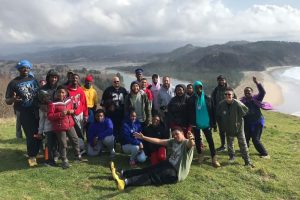
When Jason was growing up in the suburbs of Portland, nature was his refuge.
“Growing up Black in the ‘80s, the suburbs were really racist,” Jason says. “I was harassed by police all the time. Teachers discounted me. We had a wooded area in our backyard, and the West Hills were still undeveloped. I would go outside to find peace and healing.”
This is a lesson that Jason Stroman has carried with him into his work at the Blueprint Foundation, which he helped found in 2015 to address large disparities in high school retention and graduation rates for Black students in Portland’s Public high schools. What began as a mentorship program has evolved to include a workforce training program, giving students experience and exposure to career paths in the environmental field.
“I know the healing properties of nature and I’ve seen kids not benefit from that, not have access to that.”
After Blueprint was founded, they were looking for partners that made sense and could provide hands-on learning opportunities for the kids.
“I noticed lots of Friends of Trees activity in North and Northeast Portland. It seemed like a perfect fit because the students could do work right where they live.”
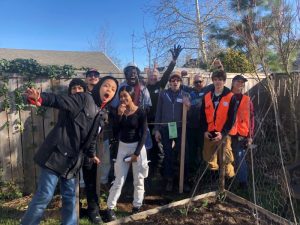
One of Jason’s goals is to demystify environmental activities for Black youth. Not only has that community been disconnected from nature in many ways, communities of color are disproportionately impacted by climate change and lack of environmental resources.
“One way we can do that is to get kids out in the neighborhoods where they live. We can give them the chance to do tangible work where they can go back and see it over the years and know it’s having a real impact.”
Blueprint’s very first planting with Friends of Trees was in the historically Black Mississippi neighborhood.
“There are 15 trees by the Masonic Lodge on Mississippi and Fremont. For kids to be able to see them nine years later, to see something they did and own it, understand its benefits—that makes me really proud.”
Beyond engaging kids with trees and their benefits, the program is designed to show them career paths in the green sector, industries in which people of color have had low participation historically.
“It amazes kids when they realize they can actually get paid to do this for a living,” Jason says. “And they are all brilliant. You get a tool in some of their hands for instance, and they pick up how to use it like that.”
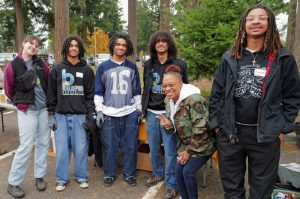
The community engagement model is another crucial piece for Blueprint’s partnership with Friends of Trees.
“A planting event might be the only time our students meet their neighbors. It creates community connections that wouldn’t happen organically.”
A favorite memory of Jason’s is a planting event in the King/Albina neighborhoods, which are historically Black but have since been gentrified.
“There are still elders who live there, but fewer young people,” Jason says.
Blueprint had about a dozen students in the neighborhood planting trees. An elderly Black man stopped his car to ask what they were doing.
“He hadn’t seen such a large group of young Black people in his neighborhood in a long time. He told us it gave him hope, not just for the kids, but for the community.”
Jason has been a board member for Friends of Trees for four years. He really believes in the value of nature-based learning, giving kids opportunities outside of the classroom, and safe and affirming exposure to new experiences. Blueprint’s goal is to replicate their success with urban forestry workforce training in other high-paying STEM fields that need increased representation.
As a mentor, Jason remembers the healing power of nature he felt as a kid himself, and it was always a tool of his to take a kid outside to help them find a moment of peace.
“It’s a dream come true to be able to provide that on a larger scale.”
Below you can watch a 2021 climate justice conversation between Jason and Friends of Trees Executive Director Yashar Vasef.
A Million Trees, A Million Stories is brought to you by our Presenting Partner, Portland General Electric.