
Tag: fruit tree care
“Everyone deserves beautiful trees”
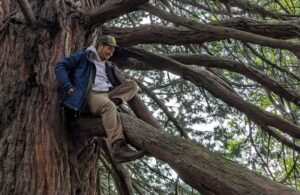
A pruner’s journey through our workforce training program and beyond
What does a chef have in common with an arborist? For Joseph Nontanovan, both roles embody the intersection of creativity and technical skill. Before the pandemic, Joseph was working as a catering chef. After the world shut down, he found himself spending more and more time in his garden in Oakland.
“I got really into plants,” he says. “It was a fun hobby, and it made sense to go from working with vegetables in a kitchen setting to working with plants in the garden.”
Joseph’s creative nature led him to a keen interest in landscape design. After moving to Portland, he enrolled in Portland Community College’s Landscape Technology program.
“When I took my first class on trees, I just started nerding out. It was amazing to go from not being able to distinguish between species to little by little knowing more and more.”
While working at the PCC Learning Garden, Joseph encountered folks from the Portland Fruit Tree Project who told him about Connecting Canopies. Connecting Canopies offers a 9-month training in urban forestry and restoration to BIPOC adults. Part of the curriculum includes 10 weeks with Friends of Trees’ Adult Urban Forestry & Restoration Training Program, focusing on a community approach to planting trees.
Learning about Connecting Canopies helped Joseph decide to pivot from studying landscape tech to arboriculture. His time in the program was especially valuable for the sense of community.
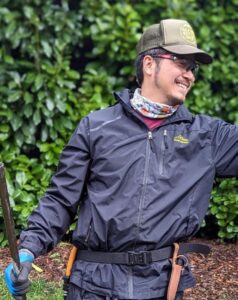
“It’s rare to find a program where you get to build such a sense of camaraderie,” Joseph says. “Working with other folks from marginalized communities, it was a uniquely safer space.”
After completing his internship at Honl Tree Care and getting exposure working at a large form arborist company, Joseph decided to find his own niche and start his own company, Thomas & Sons Tree Care, which focuses on fine pruning ornamental and fruit-bearing trees and shrubs. He’s completed his arboriculture certificate from PCC, is an associate member of the Aesthetic Pruner’s Association, and is completing his hours to become an ISA certified arborist.
“Aesthetic pruning satisfies the artistic and technical aspects of myself,” he says. “And there are a lot of shaggy Japanese maples out there!”
Joseph has been building his business locally by describing himself as an artist-technician and posting before and after videos on Instagram and Nextdoor. He’s been flooded with responses. Working in his own neighborhood gives him more time and capacity to offer services on a sliding scale.
“I really love pruning trees, so even if folks need a discount, I’m just happy to do it,” Joseph says. “Everyone deserves beautiful trees.”
You can see Joseph’s work and reach out to him on the Thomas & Sons website, Instagram, and Youtube.
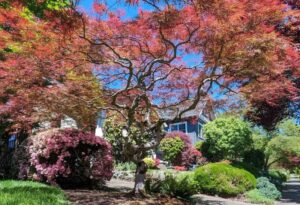
Fruit Tree Care

Have you recently planted a fruit tree? Wonder how to care for it? Presenting Fruit Tree Care 101, by Neighborhood Tree Team member and fruit tree expert Andrew Land:
Welcome to the wonderful world of home orchardry! It will not be long before you are enjoying the fruits of your labor in the form of delicious apples, pears, Asian pears, pawpaws, persimmons, and figs (the species FOT plants, but this information can apply to all fruit trees). Not only will you eventually be enjoying a steady supply of fruit, but you are also enjoying all of the economic, environmental, and social benefits that trees provide.
Fruit trees in general have some unique maintenance needs in terms of pruning, harvesting, and pest/disease management. Simply left alone, fruit trees may become more of a burden than an asset. Luckily, there are several great resources in our region to help get you and your new fruit tree(s) off to a strong start.
If you don’t already know the fundamentals of how to be an orchardist, the Home Orchard Society is a great resource for fruit tree care through its website and workshops. Additionally, the Oregon State University Cooperative Extension allows you to “ask an expert” your fruit tree questions, and if you’re north of the Columbia River the WSU Extension website has some great resources on a variety of fruit-related topics. Finally, Portland Fruit Tree Project is also a fantastic resource.
Your fruit tree will need annual pruning to ensure a regular crop and unlike a shade tree, fruit trees should be pruned the first few years they’re in the ground to establish strong architecture before the onset of fruit. We’ve distilled some of the basics of pruning into a concise basics of fruit tree pruning flier that you can print and take with you out to the garden. If you’re inspired to go more in depth or have additional questions, here’s a more in-depth fruit tree pruning basics video from an OSU Master Gardener & Clackamas College.
Beyond that, keep in mind that on your new fruit tree you should be able to make all of your cuts with bypass-style hand pruners (at left in this image) that have two blades as scissors do. Please note that anvil-type pruners are not intended to be used on live wood.
Properly planting and caring for a fruit tree is a commitment, but one that is definitely worth the effort. Questions? Feel free to email me and I’ll do what I can to help.
Pictured above: Asian pear tree in glorious bloom.