

Introduction
Welcome to the Level Arboretum! Level is excited to make their beer garden a place where people can connect with nature, enjoy the beauty of trees and native plants, and learn about some of the species planted here. Almost everything here was planted by Friends of Trees volunteers!
Since 2022, Friends of Trees has planted trees and native shrubs at Level Beer as part of a larger project designed to improve air quality in Northeast Portland and protect the Columbia Slough Watershed.
Friends of Trees inspires people to improve the world around them through a simple solution: Planting Trees. Together. Since 1989 Friends of Trees has planted one million trees and native shrubs in neighborhoods and natural areas in Western Oregon and Southwest Washington. We’ve done this with the help of tens of thousands of community volunteers.
Touring the Arboretum
At each station, there’s a QR code that will send you to the relevant section of this page. You can read along or press play to listen!
STATION #1
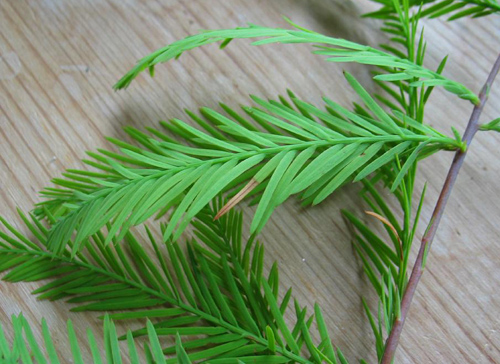
The Bald Cypress
The bald cypress is a species you’d probably expect to see in a swamp. In places like Louisiana, bald cypresses are famous for their “knees,” roots that come up out of the ground for gas exchange—you might call it breathing. This tree won’t develop those knees though, because they only grow when the tree is consistently submerged under water.
Why plant a swamp tree in Portland? It turns out that bald cypresses are really well suited to the urban environment because they are used to low oxygen conditions. Urban soils are more compacted than you’ll find in nature, which means there isn’t as much air available for the roots. A bald cypress can handle that!
The roots are also rot resistant, which is great for our wet winters here. And since they’re adapted to survive hurricanes, bald cypresses have strong, stable bases that can survive stormy weather and high winds.
There’s always a place in our hearts—and planting plans— for native trees. But in the face of climate change, and especially in urban areas, we believe that resilient non-natives have a place too.
STATION #2
The Ponderosa Pine
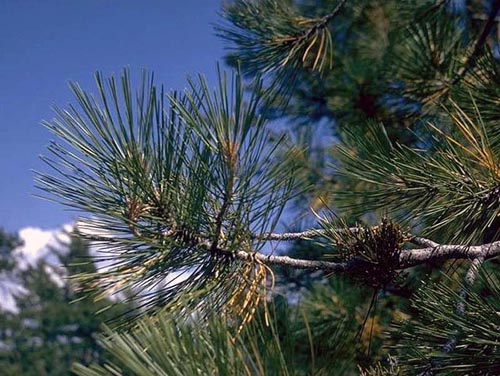
The ponderosa pine. You love this one. When you picture a pine tree, you picture this one. Its pine cones are classic pine cones. Do you want an easy way to identify it? Count the needles in a bundle. There will be three! Another fun thing to do is smell the bark. Do you smell vanilla?
Ponderosa pines are found throughout western North America, but it’s important that we don’t just plant any ponderosa pine. Friends of Trees gets our trees from a bunch of different nurseries in the region, and we want to get young trees that have the best chance to survive and thrive in their permanent home. Seedstock is really important—we make sure to source our ponderosa pines from the Willamette Valley because they are genetically adapted to this climate.
Look at this tree, and picture it years, even decades from now. Ponderosas can grow to be over 100 feet tall! Their thick bark is fire resistant, and they’re suited to high winds because they grow in sparser stands than something like a Douglas fir.
STATION #3
The Columbia Slough
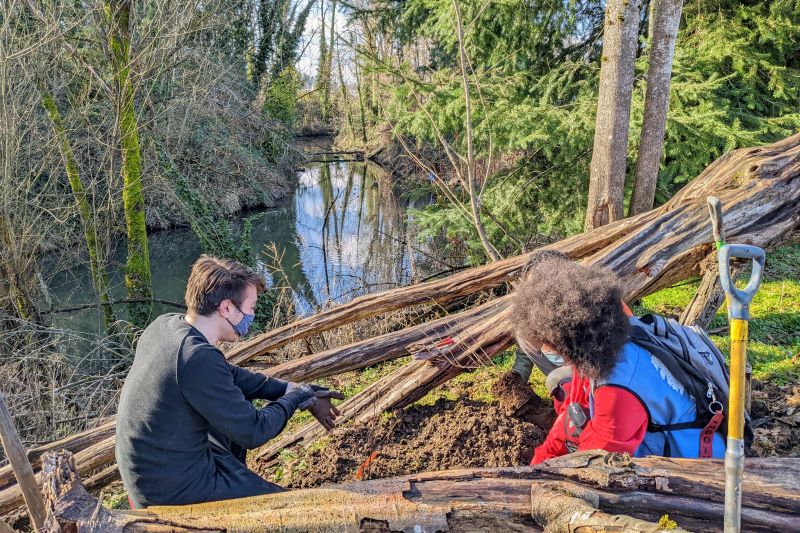
The Columbia Slough is a 19-mile waterway that runs from Gresham to the Willamette River. It’s a natural part of the Columbia River floodplain, but it has been shaped, controlled, and polluted by people for over 150 years.
Thanks to new regulations and community stewardship, the Slough is cleaner now than it used to be, but there’s still room for improvement.
The health of a waterway is hugely dependent on the health of the land around it. Plants, soil, and water interact in what’s called the “riparian zone.” Many of Friends of Trees’ natural area planting projects take place in the riparian zone, where native plants work to retain soil and improve its health, filter pollutants from water entering the waterway, create and improve wildlife habitat, and shade waterways to keep them cool.
From here you can see a bunch of mature native plants like ninebark and elderberry. You can see red osier dogwood, an attractive native shrub with something to look at year round! In the spring they have clusters of white flowers, in the late summer they have clusters of white berries, in the fall their foliage turns red to dark purple, and in the winter they have bright red twigs, making this one of the easiest native species to identify in the cold season!
You can also see pacific willow, our tallest willow, the only one that attains a tree like stature. Willows are one of the favorite sources of food for beavers. Willows are adapted to disturbance, especially floods. When a flood occurs (or when a beaver forgets its lunch), willow branches that break off are capable of starting a whole new plant. Due to this property, willows are very useful in restoration as they can be planted as “live stakes,” which are cuttings easily obtained from a mature willow.
You’ll also see plenty of Oregon ash trees. Unfortunately, these species are threatened by the Emerald Ash Borer, an invasive species recently found in Oregon. One of the reasons it’s important to plant a wide variety of plants is so that if one species begins to fail because of pests, disease or climate change, other species still remain.
STATION #4
The Oregon White Oak
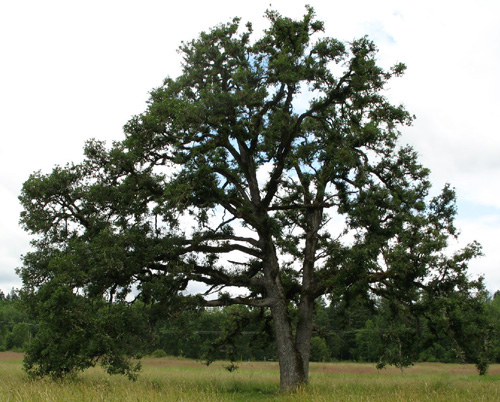
Look how big this Oregon white oak is. It’s at least a couple hundred years old. Imagine what this space looked like when it first started growing. This would have been an open oak savannah, likely managed by Indigenous people. After European settlement, it would have become farmland. Portland is called “Stumptown” for all the stumps that remained after trees were cleared. Eventually, this became an industrial urban space. This tree has seen it all, and it’s awesome that it’s still here, casting shade onto the Columbia slough, giving a home to wildlife, and connecting this beer garden to the natural history of the space.
Oregon white oaks are one of our favorite species. Oak trees are amazing providers to their ecological community, from managing the watershed to storing carbon. In those regards, it’s one of the most productive things you can put in your own yard.
Oak trees are also the backbone of our local food chains and are crucial to feeding native insects, which feed the native and migratory birds and small mammals.
This old oak has done so much in its lifetime, and we’re so grateful it didn’t become one of Stumptown’s many stumps when this area was developed. It surely has a deep taproot, a characteristic unique to Oregon white oaks that makes them drought tolerant and windfirm.
STATION #5
Native Plants
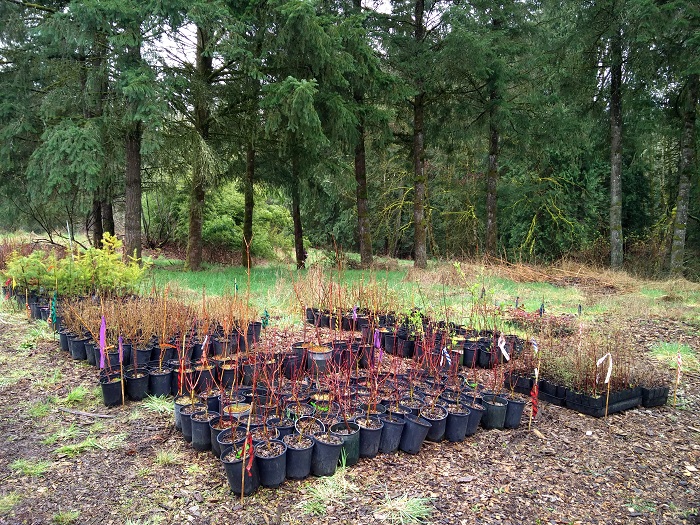
Check out these native plants, all planted by Green Space volunteers! The Friends of Trees Green Space Program focuses on enhancing natural areas with native trees, shrubs, and flowers like these. Some plants in the native section include: tall Oregon grape, mock orange, black twinberry, and two species of rose—nootka rose and swamp rose.
At a neighborhood trees planting event, volunteers will plant maybe 100 large stock trees. At a natural area planting, we plant hundreds, sometimes thousands of native plants. Quantity and variety are the recipe for success when enhancing a natural area. We also mulch the plants to retain moisture and hold back competing weeds.
Many of these plants would be happy in your yard, and would make birds and pollinators especially eager to swing by for a visit.
Tall Oregon grape and the two roses are the only ones with much to look at in the winter. You can see the distinctive leaves of the tall Oregon grape. And the roses have prickles!
A fun native tree to highlight is the cascara. These native trees have an interesting history around them. Their bark was used as a laxative before synthetic laxatives became cheaper. Native people used it for the same purpose. They were overharvested in the early 1900s, when they were used for laxative pills included in soldiers’ med kits in World War I. They also have edible berries, which aren’t all that tasty—and are technically also a laxative if you eat a whole lot of them.
STATION #6
The Ginkgo
The ginkgo tree is a living fossil. We have found ginkgo fossils dating back almost 300 million years, making it the tree species that has been around the longest out of all the species on earth. Another fun fact: ginkgo’s are the genetic link between trees and ferns!
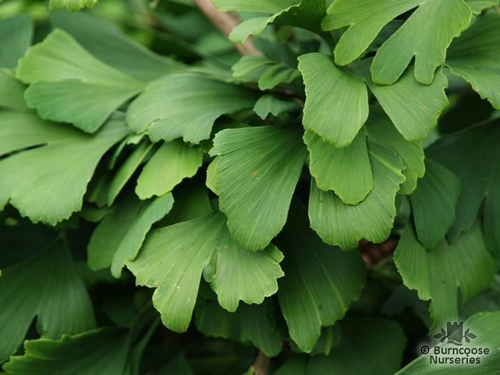
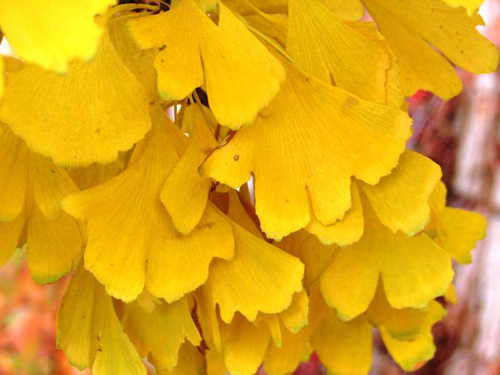
You can identify it by its distinct fan-shaped leaves, which turn a beautiful gold in autumn, making this a popular tree for people’s homes.
We generally discourage people from choosing trees for aesthetic reasons alone. We want trees to survive and thrive. Ginkgos make a great urban tree because they have a strong branch to trunk ratio, which means they can withstand high winds. And they can deal with compacted urban soil.
There are two sexes of ginkgo, but for the most part you will only find males in our urban forests. In many areas, the females are banned because the smell of their fruit is considered unpleasant. But guess what? Some males can convert to females to allow for natural reproduction!
The fruit of the ginkgo tree gives us the ginkgo nut, which is a food source in many cultures. People do collect them here in town. It’s a fatty rich nut—you just gotta get past the smelly fruit!
STATION #7
The Dawn Redwood
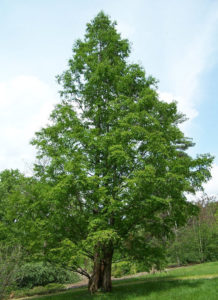
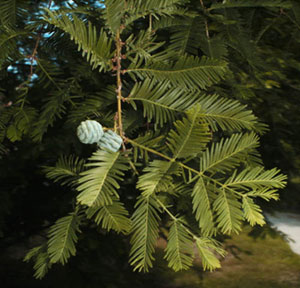
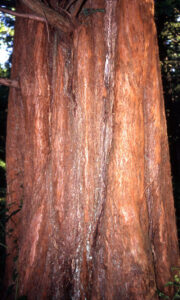
Let’s take another journey through time. Let’s go back 60 million years to when dinosaurs still roamed North America. Dawn Redwoods, like the one you see before you, were a common tree in our bioregion. We know this from fossils! Long thought extinct, a small grove of dawn redwoods was discovered in China’s Sichuan Province in 1944. With this living fossil’s genetics, dawn redwoods have returned to Oregon, and they grow really well here!
They are well adapted to a variety of conditions, which is why they originally had such a wide range across the Northern hemisphere. Technically a cedar, they are genetically related to the bald cypress. (Confusingly a western redcedar is not a cedar).
With a strong base, the storm resilient dawn redwoods grow tall and wide. We tend to plant them in parks. If you want one at home, you’ll need at least 25 feet of space!
THANK YOU FROM THE TREE TEAM
Thank you for visiting the Taproot Arboretum at Level Beer. This tour will evolve as the arboretum does—and there are always new beers on tap—so make sure you come back to visit!
Friends of Trees will plant its monumental millionth tree* this planting season, in April 2025.
Our millionth tree season is the perfect occasion to make a donation to Friends of Trees. Given the increasing severity of the impacts of climate change, getting started on our next million trees is more important than ever—and we need your help more than ever.
Your donation to Friends of Trees will play a key role in ensuring our long term ability to grow our community forest where and when we need it most, and to make sure the community is involved in the process.
Thank you for being a part of our community forest!