
Revisiting the First Trees We Planted in Eugene
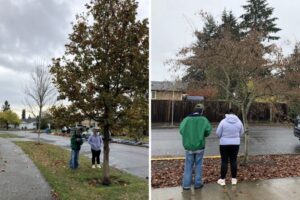
A UO student group surveyed trees from ten years ago to see how they’re doing.
You often hear us say, Friends of Trees doesn’t just plant a tree and walk away. We provide tree care guidance to recipients, plus several years of pruning and inspection. We want to make sure a tree is given the best chance to survive and thrive. After the tree is established, the tree is free to do its thing.
Holden Marsh, a Field Technician on our Eugene-Springfield team, wanted to check on the very first trees that Friends of Trees planted in Eugene, back in the 2012-2013 season. And they knew just the people to partner with.
“I connected with an Applied Ecology professor at the University of Oregon,” Holden says, “and her students were looking for projects in the community. I thought that surveying our 10-year-old trees was a perfect fit.”
The survey began in Fall 2023, with a group of students checking on each of the trees planted in the 2012-2013 season. This year, another group continued the work and visited each of the trees from the 2013-2014 season. In addition to noting the species and its survival, they also took note of each tree’s height.
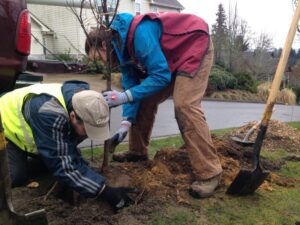
“Before this, we didn’t have a solid perspective on how these trees were doing,” Holden says. “It’s not a huge data pool, but it’s still useful. This is a project we wouldn’t have been able to do without the help of these students.”
The students found that 110 of the 150 trees planted ten years ago were still alive, a 73% survival rate.
“That’s really good,” says Eugene Director Erik Burke. “I think it speaks to our emphasis on providing treecipients with tree care support.”
There are limitations in the survey in that we don’t know the causes behind the trees that didn’t survive. Still, the data gathered can point to species with mixed success, and we can investigate whether it’s a nursery stock issue, an intolerance to some environmental factor, or something else entirely. The data also tells us which species are most successful.
“It’s great to see that the Oregon white oak is thriving,” Erik says. “These results will help us investigate trends and make tree selection decisions. I’m excited to take it further and further.”
“We’re eager to use the findings, especially if we keep doing this project,” Holden says. “I find it really fun to engage with the college students and hear their perspectives.”