
Tag: Summer Inspector Program
Tree Care Summer
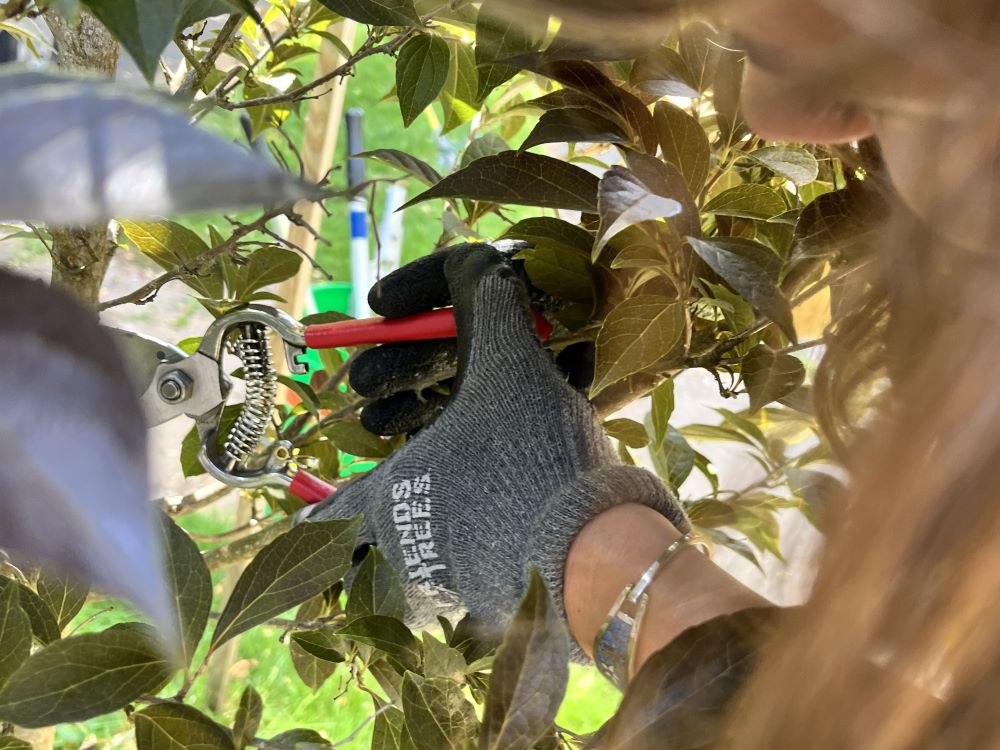
This is what Friends of Trees gets up to between planting seasons
Our planting season is from October to April, but folks at Friends of Trees keep plenty busy in the summer. We’re planning for the season ahead of course, but we’re also checking in on the trees and native plants in the ground.
You might see our Green Space team out in natural areas making sure the native plants are properly mulched and not getting overcrowded with weeds. You might see some of our neighborhood field technicians out in the community watering trees. Or you might see some of our staff at community events connecting with folks who want to plant trees at their homes!
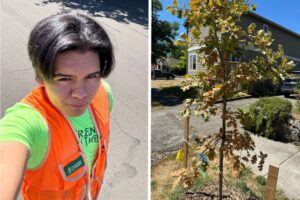
For volunteers, now is the time of year that our summer tree inspectors are visiting young trees to see how they’re faring. Summer Inspectors learn how to assess the health of newly-planted street and yard trees and give homeowners watering and mulching tips. Being a Summer Inspector gives you a chance to meet your neighbors and to help them take care of their trees during the critical first summer after planting.
One of the most important things inspectors check for is if a tree is getting enough water. Young trees require regular, deep watering (15 gallons, once per week). Young trees have a limited root system and can’t reach deeper into the soil to find water.
“Water is one of the three components of photosynthesis, along with sunlight and carbon dioxide, and it’s the only one we can control,” says Community Tree Care Coordinator Litzy Venturi. “Trees can’t make food without it. At minimum, a young tree won’t grow. More likely, especially in their first couple years, they’ll die without summer watering.”
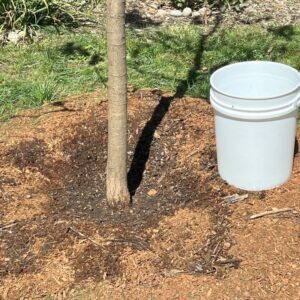
Because watering is so important and we want to make sure trees survive and thrive, the BRANCH Coalition plantings have an opt-in watering service. We also work to send watering reminders to all tree recipients and helpful feedback after their trees get inspected. Think of this Treemail as yet another watering reminder! Have you been watering your tree? Check out our tree care guide for tips like the bucket method!
For trees beyond their first few years of age, summer is one of the times when it makes sense to prune. Young tree pruning is the most cost effective thing you can do for an urban forest and it’s one of the ways we make sure our trees are cared for after they’re planted. We’ve just kicked off our summer youth pruning program. At four pruning events in Portland, youth participants will get to learn the fundamentals of pruning, get hands-on practice, and get to see different parts of the city.
The Tell-Tale Soil
Inspector Intern & The Case of the Dry Leaves
by Josh Celio Espinoza
Unleashing my inner Johnny Appleseed was not on my summer schedule. I expected to spend my Communications & Business Relations internship at Friends of Trees behind a desk, researching potential business partners and monitoring social media metrics. As it turns out, that is only half the story. The other half involves filming staff gushing about their favorite trees, exploring local parks with the community, and learning how to identify native plant species with the best of them (a.k.a, my coworkers).
Recently, my job took me to the beautiful neighborhoods of southern Vancouver to inspect trees. Armed with a pencil, clipboard, and a sunny disposition, I hit the streets. From checking the moisture levels of the soil to making sure the mulch had the perfect donut shape, I had my work cut out for me. But as they say, if you love what you do, you never work a day in your life.
The goal of the Friends of Trees summer inspection program is to make sure that our newly planted trees (in their first 1-3 summers) are healthy and thriving. As a volunteer summer inspector, you’ll get to share your tree knowledge with your community, learn how to spot healthy and unhealthy trees, and ensure the survival of these young trees.
I’ve learned that, here at Friends of Trees, we don’t just plant and walk away. If a tree has dry leaves, we figure out why. Most likely, it needs more water. Mystery solved!

When speaking with Litzy Venturi, our Community Tree Care Coordinator, I gathered that this program isn’t simply about inspecting newly established trees.
“A lot of these volunteers have gotten a tree themselves and by inspecting these neighborhoods, they get to form a relationship with not only the neighborhood trees, but the neighborhood itself. You get to bond with others in your community about your shared passion.”
After I took the requisite training, which only took me a couple of hours, I was assigned a route. A great aspect of this role is that you can make your hours. I picked a cool summer morning to explore my route’s neighborhood and find my new tree friends to see how they were doing.
The whole inspection process was cathartic, methodically checking each aspect of the tree for damage or irregularities. Even more than that, every house was unique in its inspection. Some had lush gardens. Others had intricate decorations all around. Only one had a large, loving cat named Biscuits, even if I wish he was at all the houses.
The one constant I found was that all these homeowners truly invested in their tree’s well-being. Everyone was delighted that their trees were being inspected, but even more so that they were doing their part for the environment. “I’ll be sure to be bright and early for your guy’s next planting,” said Catherine Ricci, a Treecipient. As I continue my internship, I realize that Friends of Trees goes beyond planting trees—they create a community invested in climate advocacy.
Trees Through The Years
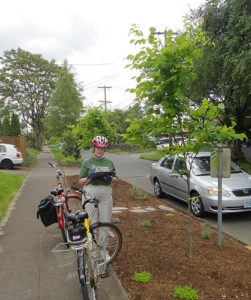
Our inspection program connects volunteers to specific trees, visit after visit.
When Friends of Trees plants a tree, we don’t just wash the dirt off of our hands and move onto the next one. We return to inspect it, to prune it, replenish mulch, and make sure everything is looking good. These check-ups are for more than just to care for that individual tree—we’re also collecting data.
Most of the data that we track is for younger trees, Tiers 1, 2, and 3, according to their age, Tier 1 being trees that were planted in the most recent season. We do this to make sure each tree was planted properly, to track the survival rates of different species, assess the quality of the nursery stock, and keep an eye out for any trends we need to adapt to.
“We also do this to provide tree care advice to the tree recipient,” Haley says. If a tree fails for reasons beyond neglect, we can replace the tree or refund the recipient.
There’s another set of much older trees that we have been collecting data on: Tier Omega. Tier Omega trees were planted in the 2010 season, and we’ve been checking on a subset of them, the same exact subset, every year since they were planted. This has created a consistent and robust data set that can show the long term survival rates of older plantings.
In the summer of 2010, 486 Tier Omega trees were planted. Since then, just 45 trees from the Tier Omega subset have died or were moved due to development reasons. Now that these trees have settled, they’re less likely to be dramatically impacted by weather, so we have been seeing fewer dead trees with each round of inspections.
“There’s this great community feel to it,” Neighborhood Trees Senior Specialist Haley Miller says about the inspection program. “We have some Tier Omega inspectors who have been inspecting the same exact trees for eleven years now.”
Mike Ablutz is one of those Tier Omega inspectors who just keeps coming back. “Revisiting the same trees over several years is like checking in with young friends,” he says. “I love seeing how they are doing, how fast they are growing, and discovering the many ways that they are adapting to life’s challenges.”
When people sign up to get a tree from Friends of Trees, they can volunteer to be tree inspectors. They are assigned a Tier 1 route of about twenty trees, including their own, that need to be inspected twice each summer. Inspectors monitor things like weeds, mulch, and water. They measure the size of the tree and look for things like bark damage. “It’s a popular volunteer role,” Haley says. “People really enjoy visiting their trees.”

The tree inspection process is also one of the ways we engage our youth education programming at Friends of Trees. Our partnerships with the Portland Opportunities Industrialization Center and the Blueprint Foundation connect students and young people to urban forestry work. In the summer, they get to help with tree inspection, which continues to develop forestry skills like tree identification, and grow their connections to nature.
We are learning more and more that when a person feels a connection to a particular tree, it grows their connection to trees and nature more broadly. Our tree inspectors are proof of that.
“I often imagine how the young trees we plant will look when they are old,” Mike says. “Tier Omega inspections allow me to revisit specific trees and at least see how they are doing in their early years.” Hopefully Mike will get the chance to keep revisiting those trees for years to come.
Friends of Trees visits Pittsburgh!

By Susie Peterson
Watch out Pittsburgh! Here comes Friends of Trees! Neighborhood Trees (NT) staff members Elizabeth Elbel and Susie Peterson will be attending the Alliance for Community Trees Conference on November 5th to present on behalf of the whole team.
Elizabeth will be partnering with Nancy Buley from Schmidt Nursery, along with Matthew Stephens from New York City Parks & Recreation, to present on how tree planting organizations can better work with their nursery partners to obtain trees that will thrive in their region. The name of their presentation is “You Can’t Always Get What You Want: Seeking and Achieving Urban Forest Species Diversity.”
Susie will present on the Friends of Trees Summer Inspector Program. She will share what we have learned throughout the years about how to encourage new tree owners to care for their trees. Who knows — maybe this will inspire another city to start a similar program. All cities would benefit from a tree care program like this.
NOTE: If you are an attendee of the conference and would like to view the mentioned Monitoring Report, or view the slideshow, click on the appropriate link below.
Friends of Trees Monitoring Report
2013 ACT Conference – Summer Inspector Program Presentation
— Susie is a Neighborhood Trees Specialist with Friends of Trees.