
Tag: business
“Everyone deserves beautiful trees”
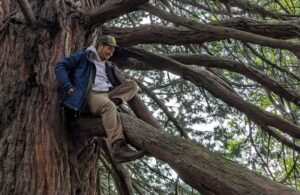
A pruner’s journey through our workforce training program and beyond
What does a chef have in common with an arborist? For Joseph Nontanovan, both roles embody the intersection of creativity and technical skill. Before the pandemic, Joseph was working as a catering chef. After the world shut down, he found himself spending more and more time in his garden in Oakland.
“I got really into plants,” he says. “It was a fun hobby, and it made sense to go from working with vegetables in a kitchen setting to working with plants in the garden.”
Joseph’s creative nature led him to a keen interest in landscape design. After moving to Portland, he enrolled in Portland Community College’s Landscape Technology program.
“When I took my first class on trees, I just started nerding out. It was amazing to go from not being able to distinguish between species to little by little knowing more and more.”
While working at the PCC Learning Garden, Joseph encountered folks from the Portland Fruit Tree Project who told him about Connecting Canopies. Connecting Canopies offers a 9-month training in urban forestry and restoration to BIPOC adults. Part of the curriculum includes 10 weeks with Friends of Trees’ Adult Urban Forestry & Restoration Training Program, focusing on a community approach to planting trees.
Learning about Connecting Canopies helped Joseph decide to pivot from studying landscape tech to arboriculture. His time in the program was especially valuable for the sense of community.
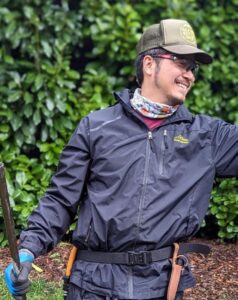
“It’s rare to find a program where you get to build such a sense of camaraderie,” Joseph says. “Working with other folks from marginalized communities, it was a uniquely safer space.”
After completing his internship at Honl Tree Care and getting exposure working at a large form arborist company, Joseph decided to find his own niche and start his own company, Thomas & Sons Tree Care, which focuses on fine pruning ornamental and fruit-bearing trees and shrubs. He’s completed his arboriculture certificate from PCC, is an associate member of the Aesthetic Pruner’s Association, and is completing his hours to become an ISA certified arborist.
“Aesthetic pruning satisfies the artistic and technical aspects of myself,” he says. “And there are a lot of shaggy Japanese maples out there!”
Joseph has been building his business locally by describing himself as an artist-technician and posting before and after videos on Instagram and Nextdoor. He’s been flooded with responses. Working in his own neighborhood gives him more time and capacity to offer services on a sliding scale.
“I really love pruning trees, so even if folks need a discount, I’m just happy to do it,” Joseph says. “Everyone deserves beautiful trees.”
You can see Joseph’s work and reach out to him on the Thomas & Sons website, Instagram, and Youtube.
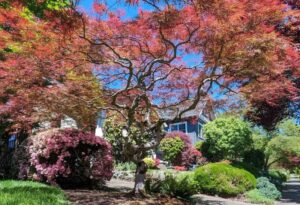
5 Questions About Backyard Habitats

So many of our Treemail readers were interested in our Backyard Certification, we wanted to offer more information about how to get certified. Fortunately, we were able to catch up with Gaylen Beatty, who founded the program in 2006 while working for Columbia Land Trust, today works closely with their partner, Audubon Society of Portland to assist the 2,700+ participants in the program. Gaylen was kind enough to go into greater detail via email about the certification process.
How long does the certification process take?
On average, it takes someone a year from the initial site visit to achieve certification. Though we support the participant for however long it takes them to achieve certification. We have many participants, who have some more difficult properties (erosion, a complex mix of invasive plants, large property) that take years to achieve certification. We have over 60% of those properties once they initially enroll that stick with the program and process to make certification.
How much does the certification process cost?
Feb 1st, we’re increasing the site visit fee to $35. That fee pays for the entire process and for the length of the time the property is within Backyard. No renewal fee for any follow up visits (certification or recertification).
What is the advantage of backyard certification?
Research is showing that even small urban lots can provide a great habitat and support biodiversity in our region. Did you know of the 500 bird species found in Oregon, 209 of those are found in the Portland-Metropolitan area for some portion of their lifecycle? Many of our participants also have some sort of food production in their garden, from vegetables to fruit trees. Providing native plants that support our native pollinators can help increase food production, even on a small lot. Having a Backyard sign in your garden, teaches neighbors, friends, etc. that you can have a beautiful garden that creates a healthy urban landscape, for people and wildlife.
How do certifications help individuals?
Our participants share stories with us almost daily on the change they’ve seen in their backyard, by making small changes in their garden to support wildlife. Here’s a quote from an email that came in earlier this week from a gold certified homeowner, “This past weekend I was in our kitchen and noticed a small creature rummaging around in the backyard in some bushes under our pine tree and Ribes. I thought at first it was just a squirrel then I noticed a bright flash of orange. I ran and got our binoculars. It was a new bird to me! I looked it up and found out it is a Varied Thrush. True it may be a common bird, but not to me. I have always maintained to more of a plant person than a bird person in my habitat work. However, the feeling of discovering a new, exciting bird in my yard gave me such a thrill. I was so proud of active “Backyard Habitat”! Just thought I’d share.”
There are over 1,000 certified homes in the Portland area, how common is it for a business to get certified?
There are 14 commercial spaces that are enrolled in Backyard Habitat. We only have four properties that are Platinum certified. Those include Green Zebra grocery store in Kenton, EMSWCD office, Apex Wellness Center and Friends Of Trees. You all fall into a small, exclusive group that showcase how an urban commercial lot can be beautiful and SO valuable for wildlife. I’d strongly encourage commercial spaces to challenge themselves to look beyond the common ornamental landscapes and become a model for what our small handful of commercial spaces have already done.