
Tag: BIPOC partnerships
A Place For Celebration
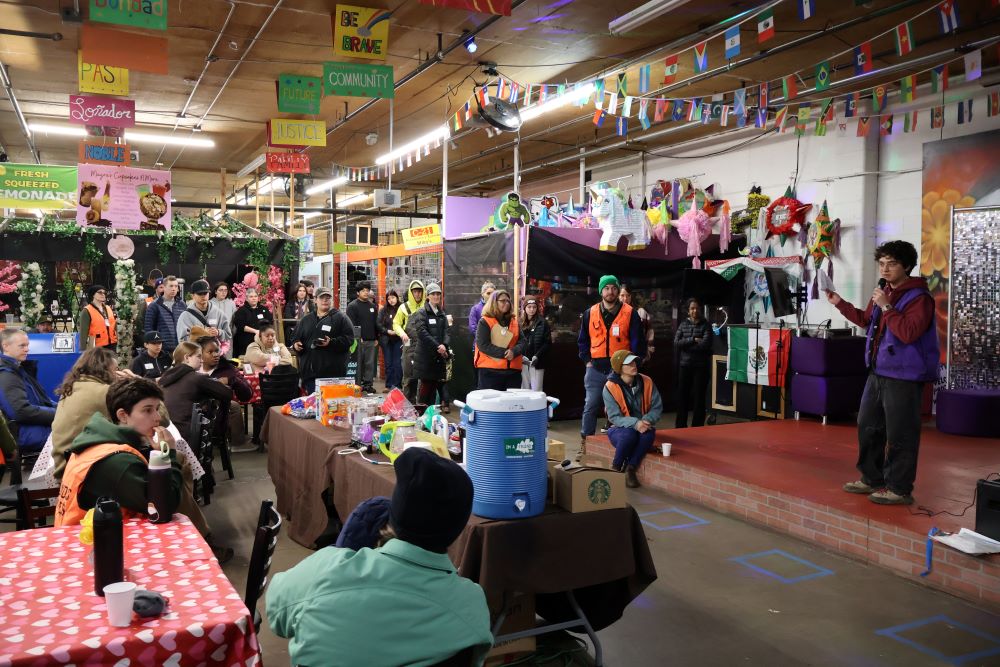
A unique Hillsboro staging site makes for incredible community building
If you’ve ever volunteered at a Friends of Trees planting, you can picture a typical event staging site. A parking lot filled with trucks, some pop-up tents over registration and a breakfast spread. At our Hillsboro planting last month, volunteers encountered something a little different.
They walked through a heart-shaped arch to register at the entrance of M&M Marketplace, a multinational mercado in the heart of Hillsboro’s Calle Diez neighborhood. Volunteers sipped coffee and ate pastries at one of the dining areas inside, among the 80 independent business stalls and food vendors. Since the first planting there in 2023, M&M Marketplace has become a go-to staging site for Hillsboro plantings, a partnership that Neighborhood Trees Specialist Mario Catani is grateful for.
“It’s the perfect spot in the heart of the planting area,” Mario says. “And we get to show the marketplace and how cool it is to people in Hillsboro who haven’t been there before.”
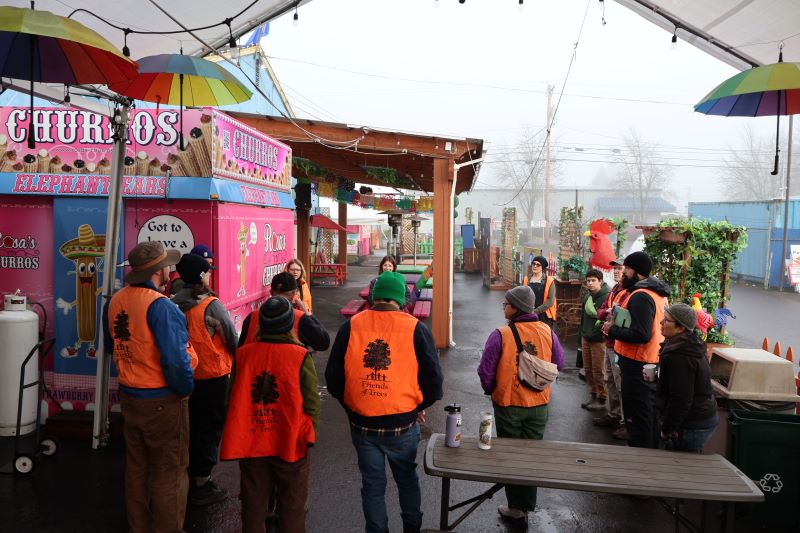
Volunteers set out to plant 40 trees throughout Calle Diez and Downtown Hillsboro, including some trees at Lincoln Street Elementary School. One of the young crew members was so excited to plant at her school! This event also marked the 300th tree that Friends of Trees has added to the Calle Diez neighborhood.
Among the volunteers was a crew of students from Centro Cultural de Washington County, which among other programs, offers a youth STEAM (science, technology, engineering, arts, and math) education program. Their Climate Justice Leadership program is designed to help young people of color learn about the environment and civic engagement through the lens of climate change. Students learn about wildlife, watersheds, and native plants, as well as topics like public testimony.
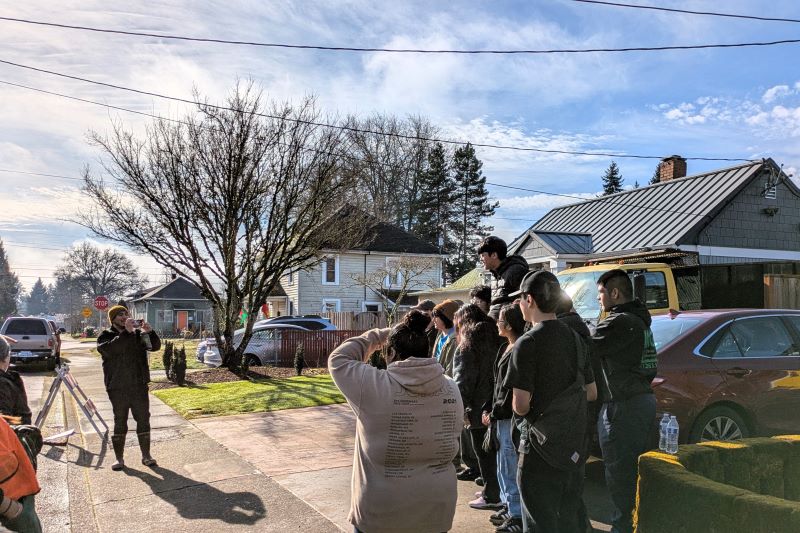
In between trees, Centro students talked about their Lego robotics competition the next day. Friends of Trees had partnered with Centro on a couple projects in the past, including a planting in Forest Grove designed to address the impending impacts of Emerald Ash Borer. We heard that students are already taking those lessons home and sharing with their families what trees they should plant to replace their ash trees when the time comes.
By the time crews got back to M&M Marketplace, the market was bustling with people shopping at stalls or getting lunch at one of the many food trucks—tacos al pastor carved right from the spit, creamy horchatas, and so much more—a perfectly lively scene to get swept up into after a morning planting trees in the neighborhood.
“The best moments of the day for me were after the planting,” Mario says. “Hanging out with volunteers on a sunny day, supporting the vendors there, especially with everything going on right now. We got to have that moment to bond and celebrate the day.”
Mario hopes to continue partnering with M&M Marketplace, exploring opportunities like community outreach, bilingual tree walks and presentations, and of course, more tree planting.
Partner Spotlight: The Blueprint Foundation
EXPANDING OUR IMPACT. TOGETHER.
Partnership is a foundational for us at Friends of Trees. We’re so grateful to our community partners who work with us to engage with the community, exchange knowledge, and expand our collective impact.
We recently connected with Curtis Young, the Executive Director of The Blueprint Foundation, which connects communities, primarily Black and underserved communities, to environmental and economic opportunities. They’re one of our historic partners and a member of our 11-member USDA grant coalition. Over the course of the five-year grant project, our coalition will work to empower disadvantaged, low-canopy neighborhoods to expand their tree canopy.
What does the USDA community forestry grant mean to the Blueprint Foundation and how will these funds impact your work?
CURTIS: The Community Forestry Grant is a transformative opportunity for the Blueprint Foundation. As a small nonprofit with a mission to connect communities, primarily Black and underserved communities, to environmental and economic opportunities, these funds will allow us to expand our impact significantly and scale our work in ways we’ve always envisioned but have not yet had the resources to achieve.
Community forestry isn’t just about planting trees—it’s about fostering environmental stewardship, creating green spaces that heal and empower communities, and providing pathways for economic growth through workforce development. This funding will enable us to deepen our programs, including our hands-on training opportunities in urban forestry, habitat restoration, and sustainable landscaping, which equip young people with the skills to pursue careers in green industries.
These funds will also allow us to engage even more communities in our work, creating spaces where people can gather, learn, and grow together.
Whether we expand tree-planting initiatives in neighborhoods that need them most or educate residents about the benefits of urban forestry, this grant will help us bring our vision of equitable, thriving communities to life.
On a broader level, this funding is a testament to the importance of organizations like ours, led by and for communities of color, in driving equitable environmental change. It allows us to build capacity, strengthen partnerships, and ensure that our impact is felt today and sustained for generations to come. We’re excited and grateful for this opportunity and eager to use these funds to create lasting, meaningful change.
What excites you about the coalition aspect of this project?
CURTIS: Being part of the coalition is an inspiring and rewarding experience. It’s exciting because it involves people and nature coming together meaningfully. Trees are vital to our lives—they clean our air, cool our neighborhoods, and bring so much beauty to our communities. Knowing that we’re working to grow and protect them, especially in partnership with others who care just as profoundly, feels incredible.
What makes it truly special is the collaboration.
When nonprofits, government agencies, and community members collaborate, they combine resources, knowledge, and passion. It’s not just about planting trees— but building relationships, creating healthier neighborhoods, and fostering a sense of pride and ownership in our shared spaces. Everyone’s voice matters, and the result is something we can all be proud of.
One of my favorite parts is the connection to the community. Trees bring people together, whether through planting events, educational programs, or simply the shared joy of walking under a canopy of leaves. You see firsthand how something as simple as a tree can transform a neighborhood—physically and emotionally. It builds hope and a sense of belonging.
And then there’s the lasting impact. You’re not just making a difference today; you’re creating something future generations will enjoy. There’s something powerful about looking at a tree you helped plant and knowing it will stand tall long after you’re gone, providing shade, clean air, and beauty for years. This work leaves a legacy, and being part of that is such a privilege.
A Million Trees, A Million Stories: Jason Stroman
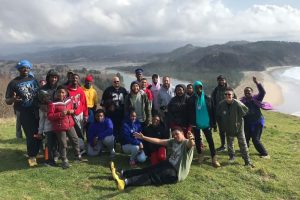
This season at Friends of Trees, we will plant our millionth tree. Our millionth tree, like all of the trees and native shrubs we’ve planted, will be planted with the power of community volunteers. We’re telling their stories! Read more here.
Nature as a refuge and a career path for Black youth
When Jason was growing up in the suburbs of Portland, nature was his refuge.
“Growing up Black in the ‘80s, the suburbs were really racist,” Jason says. “I was harassed by police all the time. Teachers discounted me. We had a wooded area in our backyard, and the West Hills were still undeveloped. I would go outside to find peace and healing.”
This is a lesson that Jason Stroman has carried with him into his work at the Blueprint Foundation, which he helped found in 2015 to address large disparities in high school retention and graduation rates for Black students in Portland’s Public high schools. What began as a mentorship program has evolved to include a workforce training program, giving students experience and exposure to career paths in the environmental field.
“I know the healing properties of nature and I’ve seen kids not benefit from that, not have access to that.”
After Blueprint was founded, they were looking for partners that made sense and could provide hands-on learning opportunities for the kids.
“I noticed lots of Friends of Trees activity in North and Northeast Portland. It seemed like a perfect fit because the students could do work right where they live.”
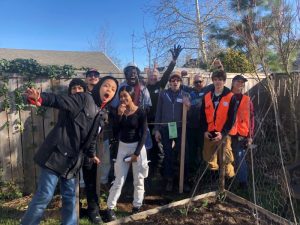
One of Jason’s goals is to demystify environmental activities for Black youth. Not only has that community been disconnected from nature in many ways, communities of color are disproportionately impacted by climate change and lack of environmental resources.
“One way we can do that is to get kids out in the neighborhoods where they live. We can give them the chance to do tangible work where they can go back and see it over the years and know it’s having a real impact.”
Blueprint’s very first planting with Friends of Trees was in the historically Black Mississippi neighborhood.
“There are 15 trees by the Masonic Lodge on Mississippi and Fremont. For kids to be able to see them nine years later, to see something they did and own it, understand its benefits—that makes me really proud.”
Beyond engaging kids with trees and their benefits, the program is designed to show them career paths in the green sector, industries in which people of color have had low participation historically.
“It amazes kids when they realize they can actually get paid to do this for a living,” Jason says. “And they are all brilliant. You get a tool in some of their hands for instance, and they pick up how to use it like that.”
The community engagement model is another crucial piece for Blueprint’s partnership with Friends of Trees.
“A planting event might be the only time our students meet their neighbors. It creates community connections that wouldn’t happen organically.”
A favorite memory of Jason’s is a planting event in the King/Albina neighborhoods, which are historically Black but have since been gentrified.
“There are still elders who live there, but fewer young people,” Jason says.
Blueprint had about a dozen students in the neighborhood planting trees. An elderly Black man stopped his car to ask what they were doing.
“He hadn’t seen such a large group of young Black people in his neighborhood in a long time. He told us it gave him hope, not just for the kids, but for the community.”
Jason has been a board member for Friends of Trees for four years. He really believes in the value of nature-based learning, giving kids opportunities outside of the classroom, and safe and affirming exposure to new experiences. Blueprint’s goal is to replicate their success with urban forestry workforce training in other high-paying STEM fields that need increased representation.
As a mentor, Jason remembers the healing power of nature he felt as a kid himself, and it was always a tool of his to take a kid outside to help them find a moment of peace.
“It’s a dream come true to be able to provide that on a larger scale.”
Below you can watch a 2021 climate justice conversation between Jason and Friends of Trees Executive Director Yashar Vasef.
A Million Trees, A Million Stories is brought to you by our Presenting Partner, Portland General Electric.

Partner Spotlight: APANO
APANO is part of our Community Forestry Grant’s 11-member coalition
For Alisa Kajikawa, it’s all about finding the balance of working toward the dream and working for the present. She’s APANO’s Community Development Manager for the Jade District, and we spoke to her about APANO’s vision for the community forestry coalition.
APANO is part of the 11-member coalition led by Friends of Trees that was awarded a $12 million Urban and Community Forestry Grant from the U.S. Department of Agriculture. The grant will fund community forestry work including tree planting, natural area restoration, post-planting care, community education, opportunities for direct community input and participation, and workforce training.
APANO unites Asians and Pacific Islanders to build power, develop leaders, and advance equity through organizing, advocacy, community development and cultural work. Their coalition work will be geared toward education and outreach, workforce development, and community infrastructure.
“We can’t grow canopy overnight,” Alisa says. “What can we do now that will still help alleviate pollution and heat in our community?”
For APANO, it means a few things, like working with businesses in the Jade district to host planter boxes filled with native plants. It means hosting community workshops on environmental justice and heat impacts. And it means thinking big picture about creating a transportation system that doesn’t rely on cars.
Alisa is excited about all the possibilities that the coalition can bring.
“When have we ever had 11 different organizations coming together as one coalition for a cohesive goal? It’s really awesome,” she says. “Hopefully this is a case study for the future, showing what happens when we stop working in silos and work toward a shared goal in different ways.”
Support our community partners
If you viewed any of our Earth Month events (here’s the playlist) you probably noticed that we often talk about partnerships and climate justice. Friends of Trees’ community includes partnerships with a number of truly impactful local organizations that work with underserved communities. Underserved communities experience the worst effects of climate change and our partnerships that help connect communities to the benefits of trees play an important role in achieving climate justice.
We have a special request of you: Support our community partners. Yes, Friends of Trees will always need you, but if we are going to achieve true climate justice we all need to support Black, Indigenous or People of Color (BIPOC) organizations that are part of the movement to ensure equitable outcomes around trees and the urban canopy.
These organizations are Friends of Trees’ partners and need your support:
Asian Pacific American Network of Oregon (APANO): Uniting Asians and Pacific Islanders to achieve social justice.
The Blueprint Foundation: Uplift, educate, and support the development of black-identified youth and other communities of color.
Portland Opportunities Industrialization Center (POIC): Committed to the success of underserved youth and adults.
Wisdom of the Elders: Native American cultural sustainability, multimedia education and race reconciliation.
If you’d like to learn more about how Friends of Trees partners with these organizations visit our website here.
Thank you for supporting our work and the work of our partners, and for being a part of the Friends of Trees community.