How trees and community can work together in the face of climate change
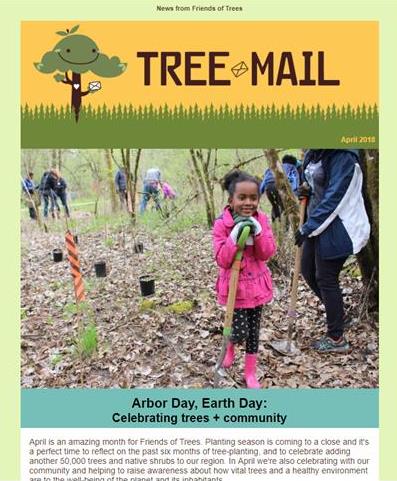
This Earth Month, we wanted to dig into the ways that we’re growing a community forest, and why trees and green spaces are such an important resource in an uncertain future. Below are excepts from “A Community Forest for the Future.”
In the face of a changing climate, trees and green spaces improve our lives
If you’ve ever gone for a walk or a jog on a warm sunny day, you might find yourself chasing shade. It’s intuitive that shade is cooler than full sun. In the face of climate change, the cooling power of shade is a valuable resource.
Studies have shown that trees can lower urban temperatures as much as 10 degrees. During a heat wave, that can be lifesaving. The 2021 heat dome served as a stark reminder that weather can have a real and devastating impact on people.
Extreme heat is becoming more common, even expected, during summers in the Pacific Northwest. Homes without shade trees will be significantly warmer and will need to rely more on air conditioning during summer months.
“Communities at this higher latitude are arguably the most underprepared for these kinds of events,” Portland State University Professor Vivek Shandas says. “We saw that really bear down on us in 2021.”
The cooling power of shade is a cost-effective way to cool our homes, parks, and sidewalks. We need to preserve the canopy we have, and continue to grow it. At Friends of Trees, we believe it takes the entire community
“Not everyone has access to trees and green spaces, which means that they don’t have access to their benefits. If we want to grow a true community forest, we need to work to expand that access and plant trees where they’re needed most.”
-Yashar Vasef, Executive Director at Friends of Trees
We must care for trees so that they can care for us
We want trees to not just survive, but thrive. When we think about trees and native plants thriving in the urban environment—and in the face of climate change—we need to think in terms of tolerance.
“Trees can tolerate all sorts of conditions, but can they really thrive to their maximum potential size and lifespan?”
-Litzy Venturi, Community Tree Care Coordinator at Friends of Trees.
Some trees are more tolerant of pollution, for example, and are good choices to be planted alongside busy roadways. Beyond tolerant, some trees are particularly good at removing particulate from the air. These are the factors we need to consider when making choices about selection. “Trees are incredible at surviving but they might just be limping along,” says Litzy.
So many things can put stress on a tree. It’s up to us to mitigate those stressors wherever we can. Some of that can be done when we select the right trees for the right place. But there is still more that we can do for a tree after its planted, especially during its establishment years.
“With climate change, we might have to be even more prepared to support trees with water and mulch,” Litzy says. “That extra level of care might help the tree thrive and be able to stave off pests and disease. And even when we plan to water, we don’t want to plant trees that need a lot of water.”
As we see shorter rainy seasons and longer dry seasons, watering becomes an important calculus. Water is critical for photosynthesis—trees need it for food. We may even reach the point where native plants will need water support after establishment.
“It’s so important that we plant in the right conditions and provide care,” Litzy says. “I like to think of healthcare for people. You do preventative care whenever you can, and respond to issues when they arise.”
Creating the next generation of climate champions
Recently, the latest cohort of Friends of Trees’ Adult Urban Forestry and Restoration Training Program finished its 10-week curriculum and moved into their internship phase. The program is designed to increase career opportunities for underrepresented communities in the urban forestry and natural area restoration fields. Many of those participants come to Friends of Trees through Connecting Canopies, which offers a 9-month training in urban forestry and restoration to BIPOC young adults.
Cata Krznarich joined the Connecting Canopies and Adult Urban Forestry programs to find career pathways into the environmental field. By meeting people who work in the field, they were exposed to real world possibilities. For Cata, it’s important to focus on putting a real dent in climate change, an issue that for many can feel too big and abstract to tackle.
“Climate change is really front and center in my mind,” they say. “It comes to mind first thing every morning with my first cup of coffee. I do try to read a lot of positive climate justice news because the negative stuff can be very daunting and very scary. And then I finish my coffee and get to work to put a little dent.”
Cata can always find reasons to be hopeful—like when “seeing flowers come up where I don’t expect.” Community, too, brings them hope. Being part of the Connecting Canopies cohort helped them see the impact that a group of people can have when they work together.
“Working with my cohort, when everyone has that same passion, it can feel like more than a dent when we plant 50 ponderosa pine trees on a rainy day.”
A community forest built by climate action
This year, an 11-member coalition led by Friends of Trees is putting into action a $12 million Urban and Community Forestry Grant from the U.S. Department of Agriculture, part of the Inflation Reduction Act (IRA) grants. The grant will fund the engagement of low canopy neighborhoods included in the Biden-Harris Administration’s Justice40 initiative, which will bring resources to communities most impacted by climate change, pollution, and environmental hazards.
The driving theme of the project is coalition building.
A community forest is a lot of things. It’s the trees, plants, and animals that live in our neighborhoods. It’s the way they contribute to the environment by cleaning air and water, creating habitat, and fighting climate change.
And it’s us. How we work together to build an equitable urban forest, where everyone has access to trees and green spaces. How we take care of that urban forest as the valuable resource that it is. How we foster an ethic of stewardship for people and urban nature alike.
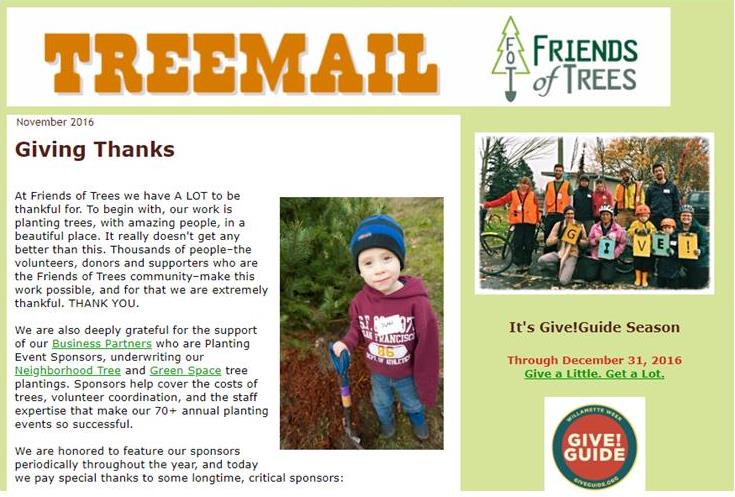
From Eugene to Vancouver, when volunteers show up to a planting event and put their hands in the earth, they’re taking real climate action. When thousands of volunteers take climate action, they’re growing a community forest, one that will support us into the future, no matter how uncertain.
EARTH MONTH 2024
Let’s grow a community forest!
This Earth Month we have a $100,000 goal to grow our community forest. Our community forest is filled with tens of thousands of trees & native shrubs, planted in neighborhoods and natural areas, with the power of thousands of community volunteers.
YOU are a part of growing our community forest! Thanks to everyone who has already shown your support.
And thanks to the very generous $50,000 challenge from the J and J Foundation, your donation doubles!
Pop quiz: Have a minute to support a clean energy future?
Protecting trees goes hand-in-hand with supporting a reliable, clean energy future. PGE makes it easy for you to support sustainable energy with several free, energy shifting programs that reward you for adjusting when you use energy.
Whether you own or rent your home, PGE has a program that can help you save a little on your bill when you reduce your energy use during peak times. Take PGE’s good energy quiz to see which type of energy shifter you are. Help protect our clean energy future and keep Oregon a great place for trees.
Our first bilingual planting ~ El Primer Evento Bilingüe de Plantar árboles de Friends of Trees | Get to know our partner: Sandy River Watershed Council